

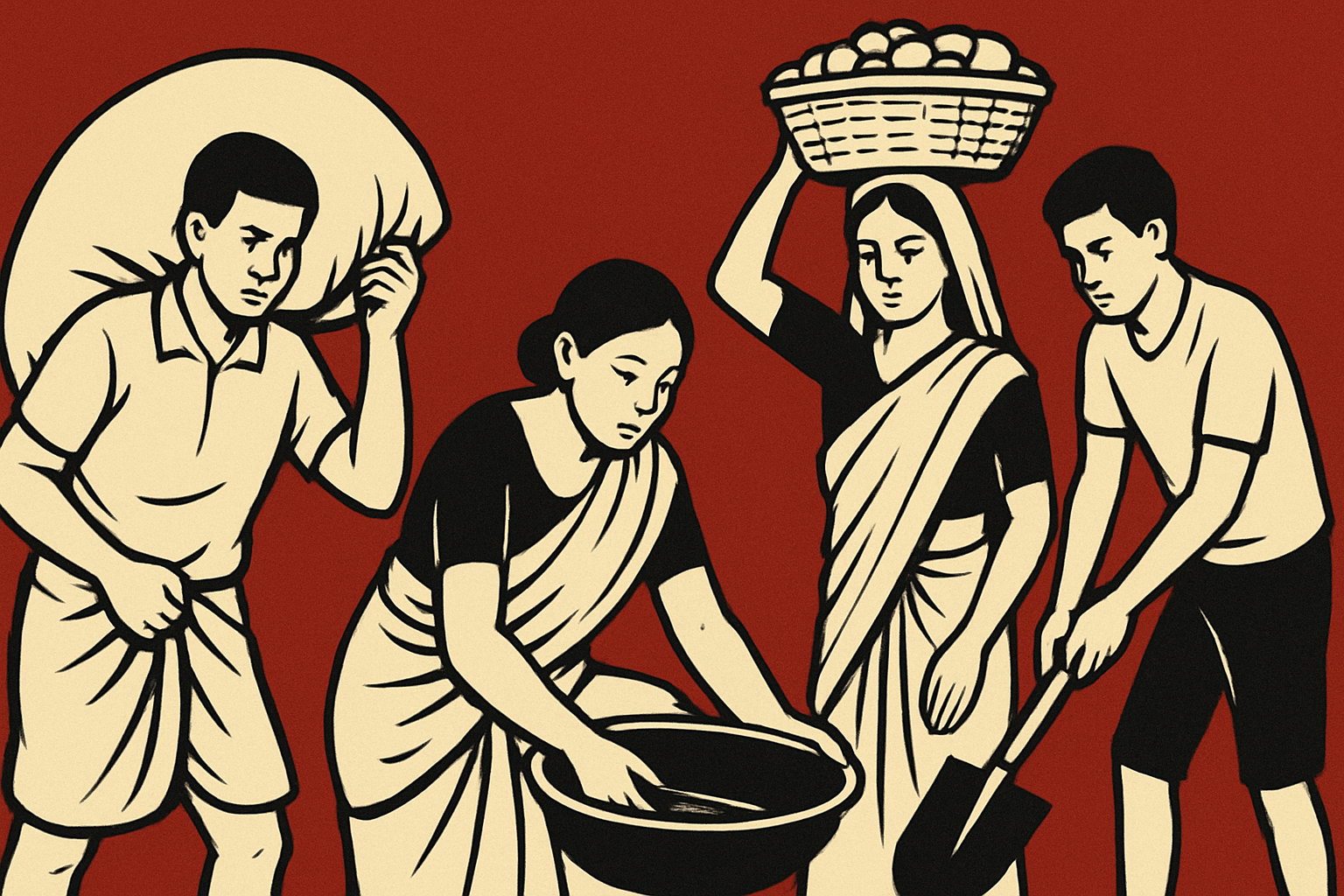
Women globally spend an average of 4.5 hours daily on unpaid care and domestic work, nearly double the 2.3 hours men dedicate to similar tasks. Our World in Data
This imbalance is not just a matter of time; it reflects deep-seated gender inequalities that permeate societies worldwide.
In every home, office space and community, there exists a silent engine driving daily life: the unpaid care and domestic labour performed predominantly by women and other marginalised groups. This labour is often dismissed as “natural”, or “voluntary”. However, this very unpaid labour is the foundation for the society to function and for economic stability as well. Yet, it remains largely unacknowledged, undervalued, and unaccounted for in economic indicators.
The Global Landscape of Unpaid Care Work
Globally, women are shown to dedicate significantly more time to unpaid care and domestic work than men. On an average, women spend around 4.5 hours daily on such tasks, as opposed to the 1.4 hours that men spend (PMC). This disparity becomes more pronounced in low-income countries, where women in rural areas can spend up to 14 hours a day on unpaid care work (Oxfam International). If this labour were to be compensated, it would constitute a substantial portion of the GDP—up to 9%. This equates to USD 11 trillion (APEC).
Despite its scale, unpaid care work is systematically excluded from national accounts and labour statistics. This omission not only erases the contributions of those performing this labor but also perpetuates gender inequalities by failing to recognize care work as legitimate economic activity.
When we talk about the wage gap, the first thing that springs to mind is the obvious gap in wages of paid work. However, when nearly three-quarters of all unpaid care work is solely taken up by women and girls, the gap becomes visible even in unpaid work. In the paid care work terms, women and girls take up two-thirds of the total workforce. According to Oxfam, they carry out 12.5 billion hours of unpaid care work every day.
Read that again, everyday.
To put the 11 trillion USD in perspective, it is potentially greater than the summed up revenue of the entire construction industry.
The majority of the world’s 67 million domestic workers are women (around 80 percent). Yet 90 percent lack access to social security, and more than half have no limits on their weekly working hours, exposing them to exploitation and long-term vulnerability.
These numbers reveal the scale, gendered nature, and economic significance of invisible labor. While it sustains households, communities, and even national economies, it is almost entirely excluded from traditional economic indicators—a systemic erasure that perpetuates inequality.
India’s disproportionate burden
In India, the gender gap in unpaid care work is stark. According to the 2019 Time Use Survey, Indian women spend an average of 4.5 hours daily on unpaid household and caregiving tasks, while men spend just 1.5 hours (Vajiram & Ravi). This imbalance is even more pronounced in rural areas, where women often bear the brunt of domestic responsibilities without access to essential services like childcare or healthcare.
This disproportionate burden has several significant socio-economic implications. It limits women’s participation, and chances of participation in the formal labour market. An estimated 708 million women worldwide—including a substantial number in India—are outside the labour force due to unpaid care responsibilities (UN DESA). In India, only 20.7% of women participate in paid employment activities, compared to 60.8% of men (Down To Earth). Even among those employed, women spend significantly less time—341 minutes per day—on paid work as opposed to 473 minutes spent by men.
Furthermore, the mental and emotional toll of unpaid care work is profound. Studies indicate that women are more likely to experience stress and burnout due to the dual pressures of paid and unpaid labour (AP News). The “mental load”—the cognitive labour of organising and managing household tasks—is disproportionately shouldered by women, leading to increased emotional fatigue and decreased well-being.
Structural Inequities and Cultural Norms
The fact that unpaid care work still exists is not just individual choice. It is deeply embedded in structural inequities and cultural norms. Patriarchal systems have historically relegated women to the private sphere of the house, associating them with caregiving roles and devaluing their contributions. These gendered divisions of labour are reinforced through socialisation, policies, economic structures, and even pop culture that fail to support shared responsibility of care work.
In India, traditional gender norms continue to dictate the allocation of domestic tasks. Even as women enter the workforce in greater numbers, the expectation that they will manage household responsibilities remains largely untouched and unchanged. This “double burden” constrains women’s economic opportunities and perpetuates cycles of poverty and inequality.
International frameworks, such as the Sustainable Development Goals (SDGs), emphasise the importance of reducing unpaid care work and promoting gender equality. However, achieving these goals requires concerted efforts from governments, civil society, and the private sector to dismantle the structural barriers that perpetuate unpaid care work.
Beyond mere numbers
All the surveys, statistics, and reports can quantify unpaid labour. What they cannot do is capture the exhaustion, the resentment, the lack of choice, and the quiet erosion of self that comes from always giving and rarely being seen.
There is a cultural laziness built into the way the society is functioning currently. The world expects women and marginalised workers to manage life itself, but conveniently refuses to acknowledge that this management is also work. It’s not generosity—it’s exploitation.
Think about it: the woman who wakes up everyday before everyone else, plans the day, calms the tensions, and somehow still shows up at work as if nothing has happened. Or the migrant worker whose back breaks in someone else’s home while her own family struggles far far away.
We pat ourselves on our backs for the hard work and grit we have shown, while leaving invisible labourers unnoticed. Again, that is not meritocracy—it is moral negligence.
The Illusion of Choice
What’s more insidious about unpaid care work is that society convinces women that it is a choice—that they are somehow “naturally suited” for it, or that their fulfilment comes from serving others.
From childhood, girls are socialised to internalise care as a duty rather than a labourious task. Dolls teach them nurturing, household chores become character-building exercises, and compliments like “you’re so caring” become rewards for work no one even pays for.
Cinema and television only reinforce this. Bollywood and regional films are filled with women who are self-sacrificing, endlessly patient, and emotionally resilient. Soap operas glorify mothers, daughters, and wives who silently manage crises while men take the spotlight. Even “strong female characters” are often defined by loudness, anger, or the ability to absorb abuse, rather than independence or fair share of labour.
Popular culture repeatedly tells women: this is who you are; your labour is love; your sacrifice is virtuous.
Every single advertisement, social media trend, and family anecdote chips away at the notion that unpaid labour is a choice. It’s often portrayed as inherent to womanhood, a moral obligation, or an act of selflessness.
This conditioning ensures that the cycle continues: women bear the labour and men benefit from it. Society, like the hypocritical audience it is, lauds the very inequity it perpetuates.
The “choice” is an illusion. In reality, women often have no viable alternative—no systemic support, no equitable redistribution of responsibilities, and definitely no rest. What is framed as voluntary is often coercive, invisible and relentless.
We need a shift
We need a shift, not just in policies and laws, but in mindset. Recognition can’t be a quiet nod. It must be loud, structural and unavoidable. We need to stop romanticising sacrifice and start questioning the way society depends on it.
Until we do, the world will continue to run smoothly, but it will be at the expense of those who never asked for the burden of holding it together. And that is a quiet brutal injustice.