
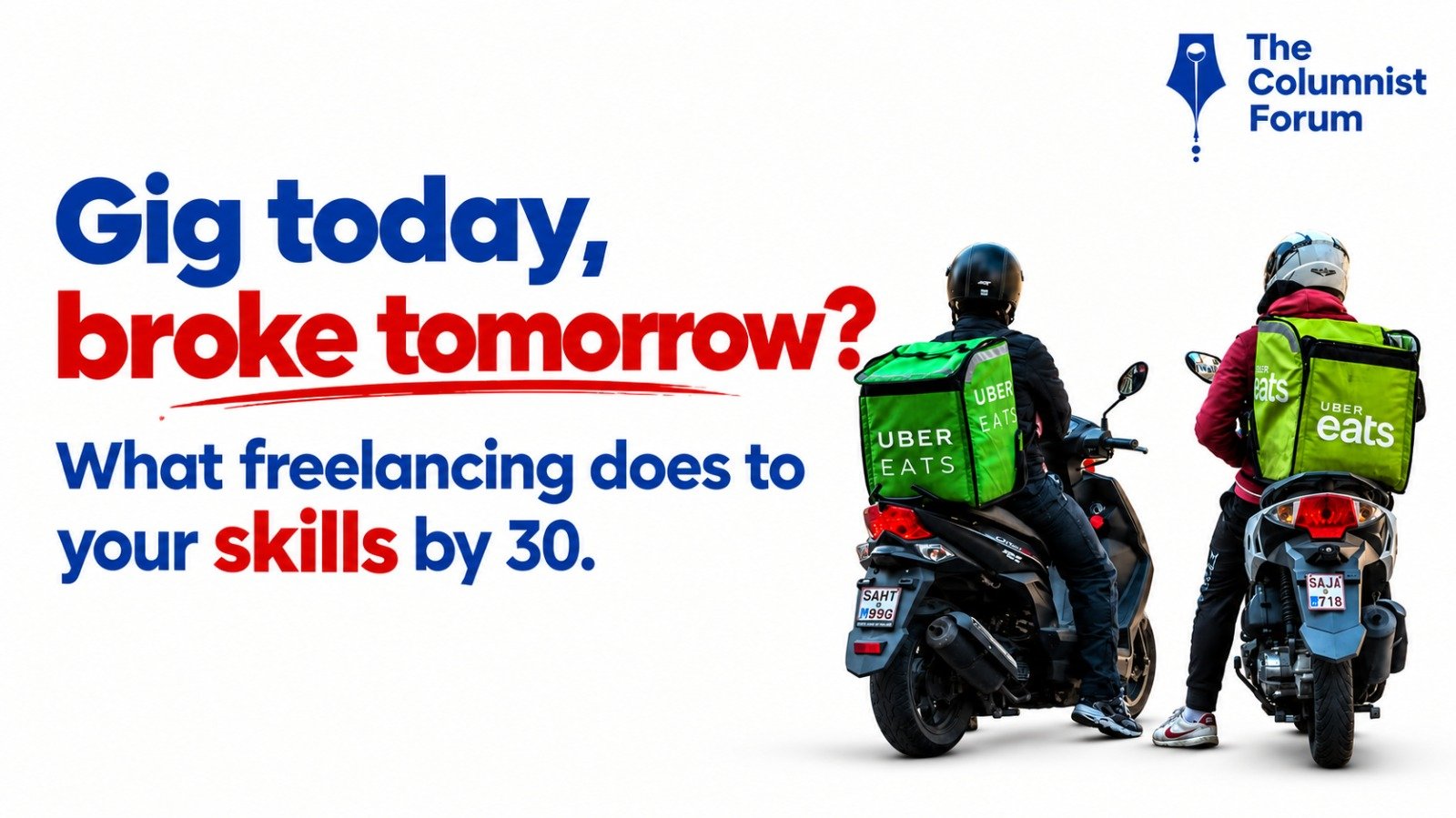
The gig economy has changed the way millions of people enter the workforce. Food delivery, ride-hailing, freelance writing, graphic design, online tutoring, virtual assistance, coding, consulting, and countless other forms of independent work have created opportunities that did not exist in the same form a generation ago.
For a recent graduate, gig work can look like an obvious solution. We can start quickly, earn money without waiting months for a corporate interview, choose when we work, and sometimes earn more in the short term than we would in an entry-level position.
But there is an important distinction between earning an income and building a career.
Gig work is not automatically bad, nor is traditional employment automatically good. The real question is whether the work we are doing is helping us develop skills, experience, professional relationships, financial security, and career options over time.
If we spend our twenties performing repetitive tasks without deliberately building transferable skills, the consequences can become much more visible around 30.
Why Gig Work Looks So Attractive in Our Twenties
The appeal of gig work is easy to understand.
After graduation, we may face months of uncertainty. Employers demand experience from candidates who have barely entered the workforce. Entry-level salaries may be disappointing, while living expenses continue to increase.
Gig platforms offer something traditional employment often does not: immediate access to income.
We can register, complete the required process, accept work, and start earning. There may be no lengthy recruitment process, no formal office hierarchy, and no requirement to wait for a perfect opportunity.
The flexibility is another major attraction.
We can work around education, family responsibilities, another job, or personal commitments. For someone temporarily between jobs, this flexibility can be extremely valuable.
The problem begins when temporary flexibility becomes a permanent career strategy without a development plan.
There is nothing wrong with using gig work to pay rent while searching for a better opportunity. The risk comes when months become years and we stop asking whether our work is making us more employable.
Gig Work vs Career-Building Employment
A job does more than provide a monthly salary when it is structured properly.
A conventional workplace can expose us to colleagues, managers, clients, deadlines, software, internal systems, professional communication, performance reviews, workplace politics, project management, and industry-specific processes.
These experiences can gradually increase our professional value.
Consider what we might learn during our first few years in an organization:
- How to communicate professionally
- How to collaborate with different personalities
- How to manage deadlines
- How to use industry-standard software
- How to handle clients and customers
- How to solve problems under pressure
- How to receive and implement feedback
- How to document and present our work
- How to manage projects
- How to take responsibility for measurable outcomes
These skills can become increasingly valuable as our careers progress.
Gig work can provide some of these experiences, particularly when we operate as independent freelancers. However, highly repetitive platform-based work may provide far fewer opportunities for structured professional development.
The issue is therefore not whether a person is technically “employed” or “self-employed.”
The issue is what we are learning while we work.
Is Being Busy the Same as Building Skills?
One of the biggest traps in the gig economy is confusing activity with progress.
We can work eight, ten, or twelve hours a day and still acquire very few new professional skills.
A delivery worker may complete hundreds of deliveries. A freelancer may produce hundreds of simple designs. A content worker may complete hundreds of repetitive assignments.
The volume can look impressive.
But when applying for a professional position, the employer may ask a different question:
What can we do now that we could not do three years ago?
That question exposes the difference between work experience and career development.
Experience becomes valuable when it increases our capabilities.
If our responsibilities remain almost identical year after year, our income may increase temporarily, but our long-term career value may not increase at the same rate.
The Skill Gap Can Become More Visible Around 30
At 22, a career gap of one or two years may not appear particularly serious.
At 30, the same period can look very different.
By that stage, some professionals may have accumulated years of experience in management, technology, sales, finance, operations, marketing, healthcare, design, or other specialized fields.
They may have moved from junior positions into roles involving greater responsibility.
Meanwhile, someone who spent the same period performing work with limited skill progression may suddenly face a difficult question:
What professional direction have we built?
This does not mean gig workers are less intelligent or less ambitious.
It means that career capital accumulates differently depending on the type of work we perform.
Career capital includes our skills, credentials, portfolio, reputation, network, experience, and ability to solve increasingly complex problems.
The earlier we begin building it, the more options we typically have later.
The Financial Cost of Gig Work Is More Than the Daily Earnings
Another important consideration is the difference between gross income and financial security.
Gig workers may look at their weekly earnings and conclude that they are doing well financially.
But income is only one part of the equation.
Depending on the country, employment arrangement, and platform, independent workers may not automatically receive benefits associated with formal employment.
These can include:
- Employer retirement contributions
- Paid vacation
- Paid sick leave
- Health benefits
- Insurance
- Bonuses
- Severance protections
- Training budgets
- Employer-supported professional development
When these benefits are absent, workers have to create their own financial safety systems.
That requires discipline.
We need to budget for periods when work declines, establish an emergency fund, arrange appropriate insurance, plan retirement contributions, and account for taxes and business expenses where applicable.
The headline income may therefore tell only part of the story.
Income Volatility Can Make Long-Term Planning Difficult
One of the defining characteristics of many gig jobs is variable income.
A strong month can create optimism.
A weak month can erase it.
Demand may change because of competition, platform policies, seasonal patterns, economic conditions, algorithmic changes, customer behavior, or pricing decisions.
For someone with substantial savings and multiple income streams, this volatility may be manageable.
For someone relying entirely on gig work to pay rent and household expenses, it can create a cycle in which every slow period consumes previously accumulated savings.
That makes long-term planning harder.
The solution is not necessarily to abandon gig work. Instead, we need to treat variable income differently from a predictable salary.
Freelancing Can Be Different From Platform Gig Work
It is important not to place every independent worker into the same category.
There is a major difference between platform-based task work and specialized freelancing.
A professional freelancer who develops websites, writes technical documentation, creates brand identities, manages advertising campaigns, provides accounting services, or builds software may continuously increase their market value.
They can develop a portfolio, specialize in a niche, raise prices, build client relationships, collect testimonials, create systems, and eventually hire other people.
That type of freelancing can become a genuine business.
The danger lies primarily in remaining trapped in low-value, repetitive work without a strategy for moving upward.
How We Can Turn Gig Work Into a Career Advantage
Gig work does not have to become a career dead end.
We can use it as a financial bridge while deliberately building professional skills.
1. Choose One High-Value Skill
Instead of trying to learn everything, we can select one marketable area.
Examples include:
- Web development
- Graphic design
- Digital marketing
- Video editing
- Copywriting
- Data analysis
- Accounting
- Sales
- Search engine optimization
- UI/UX design
- Cybersecurity
- Project management
The objective should be to move gradually from selling time to selling expertise.
2. Build a Portfolio
Certificates alone rarely demonstrate everything we can do.
A portfolio gives potential employers and clients evidence.
We can create sample projects, case studies, before-and-after examples, campaign results, websites, designs, articles, dashboards, or other work relevant to our target profession.
3. Keep Learning While Earning
If gig work pays our bills, we can use part of our time to improve our future earning potential.
Even five focused hours each week can accumulate into significant development over several years.
The important principle is simple:
Our income should support our career development rather than replace it.
4. Build Professional Relationships
Networking is particularly important for independent workers.
We should connect with people working in our target industry, participate in professional communities, attend relevant events, and maintain relationships with previous clients and colleagues.
Many opportunities never appear on public job boards.
They emerge through relationships.
5. Create Financial Protection
Gig workers should treat savings as a business requirement rather than an optional luxury.
An emergency fund can provide breathing room during periods of low demand.
Retirement contributions and appropriate insurance can also help prevent today’s flexibility from becoming tomorrow’s financial vulnerability.
What Platforms and Policymakers Can Do
The responsibility should not fall entirely on workers.
The gig economy has become an important part of modern labor markets, and policymakers and platforms can influence whether it creates sustainable opportunities.
Potential improvements include portable benefits, accessible training programs, transparent payment structures, worker protections, financial education, and opportunities for verified skill development.
Platforms could also help workers understand how their current work connects to future opportunities.
A delivery platform, for example, could provide optional training in customer service, logistics, driving safety, financial planning, or entrepreneurship.
The objective should not be to turn every gig worker into a corporate employee.
It should be to make sure flexibility does not come at the permanent cost of economic mobility.
Should We Avoid Gig Work in Our Twenties?
Not necessarily.
For many people, gig work can provide an essential bridge.
It can help us survive after graduation, support our families, finance education, supplement another job, or give us the flexibility to manage personal responsibilities.
The mistake is assuming that earning money today automatically means building a stronger tomorrow.
If gig work is part of our plan, we should give it a clear purpose.
Perhaps it is funding a professional certification.
Perhaps it is paying for a degree.
Perhaps it is helping us build a freelance portfolio.
Perhaps it is temporary income while we search for permanent employment.
A defined purpose makes gig work a strategy rather than a default.
The Real Question We Should Ask Before Turning 30
Instead of asking whether gig work is good or bad, we should ask a more useful question:
Are we becoming more valuable every year?
If our skills are improving, our network is expanding, our income sources are becoming stronger, our savings are increasing, and our professional options are growing, we are building something.
If we are simply working more hours to maintain the same lifestyle while learning little and saving little, we should reconsider our direction.
By 30, the difference can be substantial.
Two people may have worked equally hard for eight years, but one may have accumulated specialized skills, professional connections, savings, credentials, leadership experience, and a strong portfolio.
The other may simply have accumulated more hours worked.
That is the central challenge of the gig economy.
Conclusion: Flexibility Should Not Replace Progress
The gig economy has created opportunities for millions of workers, but flexibility and career growth are not the same thing.
Gig work can provide immediate income, independence, and valuable experience. It can also become financially and professionally limiting when we remain in repetitive, low-growth work for years without developing transferable skills.
We should therefore think of gig work as a tool.
A tool can help us survive a difficult period. It can finance education, build a business, provide flexibility, or open a door into a new industry.
But a tool becomes dangerous when we mistake its usefulness today for a guarantee of security tomorrow.
The strongest approach is to combine income with learning, flexibility with planning, and short-term work with long-term career development.
By the time we reach 30, the most important asset we can have is not simply a record showing how hard we worked.
It is evidence that we became more capable, more financially secure, and more valuable with every passing year.