
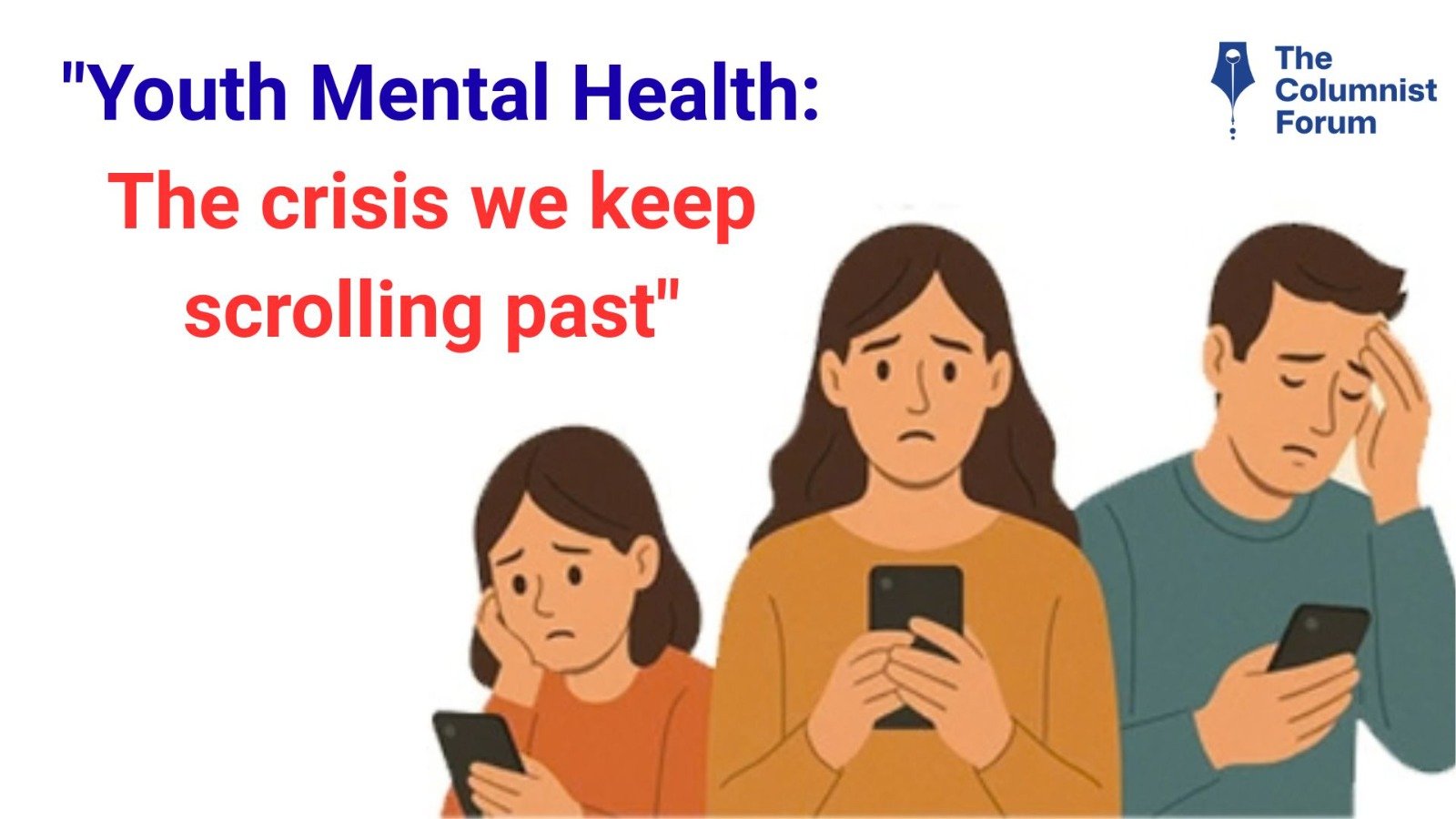
A seventeen year old checks their phone 200 times in a day and nobody calls it addiction. A college student cannot sit through a lecture without a vape break and we call it “stress relief”. A twenty something needs a drink to get through a panic attack, and we call it “unwinding”. We have become a generation who built an entire thesaurus just to avoid one word, addiction. Because actually saying it out loud would mean admitting how many young people are drowning while the rest of us are just handing them better floaties rather than teaching them to swim.
This is no longer a story about a few ‘troubled teens’ anymore. It’s a story about an entire generation being handed coping mechanisms disguised somehow as conveniences. For a system which still treats addiction and mental health illnesses as separate occasional problems, instead of treating them as the symptoms of the exact same crisis, this seems like a lost war.
The Damage Is In Macro Level
Youth mental health has been going downhill for over years now. Addiction, a word we hear in every conversation, has been equally rising alongside it. That is no longer a coincidence. It’s a continuous loop which no one seems to be acknowledge.
There are several patterns that have been showing up again and again across colleges and campus surveys:
- There has been a rising anxiety and depression cases among college age students which are getting reported quite earlier than previous generations did.
- There was a sharp increase in behavioural addictions like social media, gaming, online gambling which gets hidden in toxicology reports. However, does the same harm as substances do.
- Substance use increasingly framed as ‘self-medication’ by young adults themselves. This is a bigger worry than it may sound.
- The persistent gap between the people who are struggling and those who actually access real professional support.
None of these exist in isolation. A student who can’t sleep because of anxiety reaches for something that can numb it. A student who’s self-medicating loses the ability to regulate emotions without this dependency. This shows that the line between mental health issues and addiction isn’t a line at all but rather a loop, which nobody notices to even erase.
Why Do Young People Even Need Such Escapisms:
This generation didn’t create stress just like that. What it inherited is a unique relentless version of it, academic pressure before the child even hits puberty, a perfectly rigged job market before they’ve even entered it, a digital media engineered to quite literally engross you into it.
To name, three forces are responsible broadly for the damage and they rarely get named:
- Manipulative dependency: social media, gaming, gambling apps are all built by design teams whose entire job is maximising time spent on these apps and not digital wellbeing. When a whole team of organisational psychologists is assigned a job to simply increase consumerism, the addiction is doing the platforms PR for free.
- Chronic stress: Competitive exams, placement anxiety, family expectations create a chronic stress for the students with no release valve and nobody teaching how to process it.
- A culture which considers therapy is for the ‘crazy’: Many youngsters seek professional help only after a crisis point because in this culture, mental healthcare is still stigmatised to be for the ‘crazy people’.
- Put an entire generation through infinite pressure and hand them addictive escape routes, then act surprised when the addiction rates increase. The surprise is frankly the most unconvincing part of the entire story.
What Keeps Failing Isn’t The Awareness:
It’s not that nobody is talking about mental health anymore, awareness has genuinely improved throughout these years. The failure is when after the campaign wraps up, everyone goes back to business as usual. So, is it all for clout?
- Access over awareness: A well designed Instagram counsellor is even dangerously inadequate than most schools and colleges.
- Stigma around mental health: Many families in India we still treat addiction as a moral failure and mental illness as an embarrassment. This results in pushing youngsters toward secrecy instead of support and guidance.
- Treating addiction without mental healthcare: A student who is struggling with substance use often gets referred to de-addiction services while the post traumatic anxiety underneath goes untreated.
The Cost Of Being Avoidant To The Situation:
Every year addiction is treated as a collection of individual struggles rather than a systematic crisis. Another batch of young people grows into adulthood preferring to numb their feelings rather than healing from them. This becomes more and more predictable when the system responsible for building the problem never got around building support for it.
Its time people notice that the conversation around youth mental health and addiction doesn’t need another awareness campaign, but rather honest accountability. They created the crisis, platform after platform. Fixing it might as well take the same deliberate effort, not slogans, but structures that actually work when a young person needs help.