

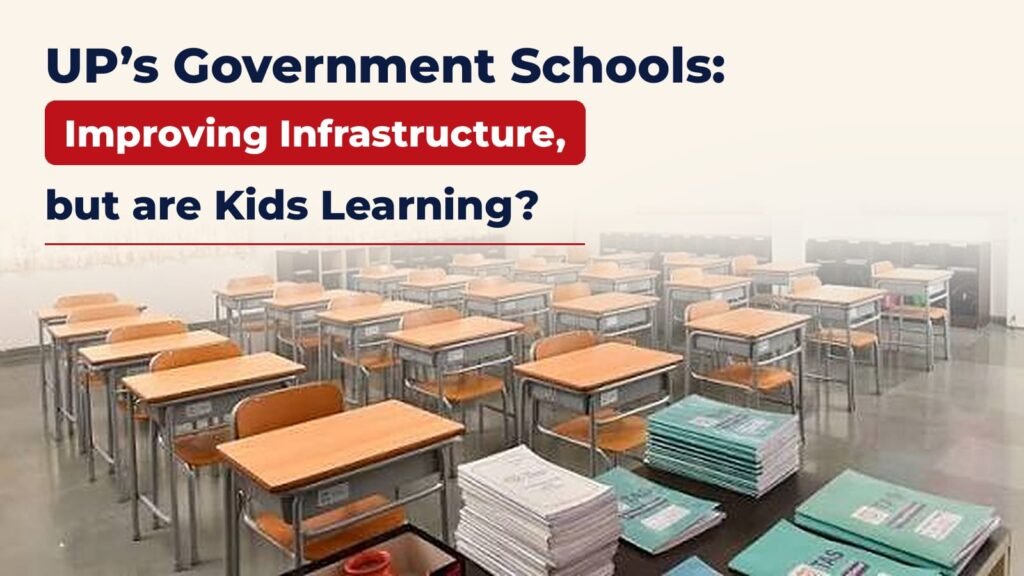
While having brand new buildings, smart classrooms and modern facilities may seem like improvements to students’ education, parents in Uttar Pradesh may wonder if their children are learning more. Are there enough teachers in the classroom? Can children read, write and do basic maths?
While Uttar Pradesh has made some improvements to improve government schools such as upgrading infrastructure, providing digital learning, increasing teacher recruitment and improving literacy, stats, Assembly debate and other independent reports show that there is still an issue with quality of education.
With the 2027 Assembly elections looming, it’s important to consider how government schools are performing.
Huge teacher’s vacancies
One of the main issues for government schools in Uttar Pradesh is a lack of teachers. Without enough teachers in the school, the quality of education will suffer.
During the Uttar Pradesh Assembly Monsoon Session in August 2025, Pankaj Patel, Anil Pradhan and Prabhu Narayan Singh Yadav from the Samajwadi Party raised concerns. In response to questions about merging schools and teacher vacancies, the Minister of State for Basic Education, Sandeep Singh, stated that the government did not intend to shut any schools. However, schools with less than 50 students were being merged with other schools in the surrounding area (within 1km).
He then gave information about how many teachers there were available. There are 10,493,389 students in primary schools, however there are only 417,886 teaching posts available, with 338,590 filled. For upper primary schools there are 4,314,803 students in schools, however there are 162,198 teaching posts available, with 120,860 teachers.
More recently, the Union Education Ministry’s Project Approval Board review of Uttar Pradesh’s Samagra Shiksha plan for 2026-27, has highlighted that 77,400 of the 2,50,488 teaching positions available in elementary schools are vacant. Whereas only 4,421 positions are vacant out of the 11,083 available in secondary schools.
This shows a large discrepancy between how many positions are available compared to how many teachers there are. However, the issue is not just about how many positions are available; it’s about how the teachers are distributed. If there are no Maths or Science teachers in a remote school, this is an issue.
Teachers need to be recruited but also effectively placed.
The learning curve of students
One of the most important parts of an education system is what the students are learning in class. Looking at the Annual Status of Education Report 2024, there are some positive findings.
In 2024, 27.9% of Class III students in government schools can read a Class II text. This is up from 12.3% in 2018 and 16.4% in 2022.
There is also an improvement in basic maths. 31.6% of Class III government school students can now do at least subtraction. This is up from 11.2% in 2018 and 19.7% in 2022.
This is a positive improvement, especially considering the disruption in education due to the pandemic. However, there is still a long way to go. Even in 2024 less than 3 in 10 Class III students in rural government schools can read a Class II text.
Although the state has started improving literacy and numeracy through the NIPUN Bharat Mission, students can often lose these early improvements as they progress to upper primary and secondary. Improved enrolment rates do not equal improved education – students need to learn to read, write and do maths.
What does data reveal
Looking at the UDISE+ data, there are 15,73,705 teachers in Uttar Pradesh, within pre-primary to secondary schools. There are 2,65,278 schools within the state overall.
However, this data is averaged across the state.
In 2024-25, there are 8 students per teacher in the foundational stage, 13 in the preparatory stage, 22 in the middle stage and 33 in the secondary stage.
It’s important to note that the secondary stage has a high number. The National Education Policy 2020 highlights that the student’s teacher ratio should be less than 30:1 at school level. Areas that have a high number of disadvantaged students should have a low students teacher ratio.
Overall, this gives a good insight into how many teachers there are, however it doesn’t tell us if there are enough teachers in every school. A district may have a good average but there may be severe shortages in individual schools. It is important to look at how many teachers there are per school and how many teachers there are in individual subjects.
Budgetary allocation
The funding shows what the government prioritise in education.
In the Uttar Pradesh Budget 2026-27, the state increased funding to Education, Sports, Arts and Culture by 28%. The state has allocated ₹1,08,154 crore.
Of this, ₹7,738 crore has been allocated to Primary Education within the Samagra Shiksha Abhiyan scheme. ₹55,792 crore has been given to non-government primary schools.
However, looking at how much has actually been spent, in 2024-25 the state spent ₹82,646 against the original budget of ₹1,00,335. This is a decrease of around 18%.
PRS also highlighted that the state is allocating only 12.8% of their total expenditure to education. Whereas on average states have allocated 14.5% in last year’s budget.
Whilst this is not solely for government schools, it shows that there are concerns about how effectively the funding is being spent.
The success of the education budget should not just be measured by how much money has been announced. It should be measured by how many improvements have been made to the classrooms, how many teachers are available, how functional the facilities are and the improvements in students learning.
School Mergers : Positive impact or a Downfall?
Merging low enrolment government schools has become a key issue in Uttar Pradesh.
The government have stated that this is to improve resource allocation and teaching. The Basic Education Minister stated that there were no closures, just merging with nearby schools during the Assembly debate in August 2025.
However, it’s important to consider the effects on students and families. How far will they have to travel? What transport is available? Are there enough classrooms in schools? How will this affect girls and disadvantaged students?
Whilst it may improve teacher allocation in one school, it can cause issues for children in another village. This will depend on how carefully decisions are made. If families rely solely on government schools, this can affect how regularly their children attend.
The way ahead for the government
Uttar Pradesh have made improvements to their government schools’ system in some areas. ASER has shown improvements in foundational skills, with increased investment in education. The education budget has also increased.
However, there are concerns about teacher vacancies, unequal distribution, knowledge gaps and merging schools.
With the 2027 Assembly elections approaching it’s important to look past how many buildings have been opened, what facilities are available and what schemes have been announced. Parents want their children to have teachers in schools, functioning classrooms and gain the skills they should have for their grade.
The real measure of education success is not how many children are attending government schools but how many are receiving an education to prepare them for the future.
Use up and down arrow keys to resize the meta box pane.
Move upMove downShow or hide panel
Optimize your content for discovery or get new co
The task facing Uttar Pradesh is to make sure that the improvements in infrastructure and funding, results in regular improvements in classrooms.



Comments