
Where Time Moves to the Rhythm of the Loom
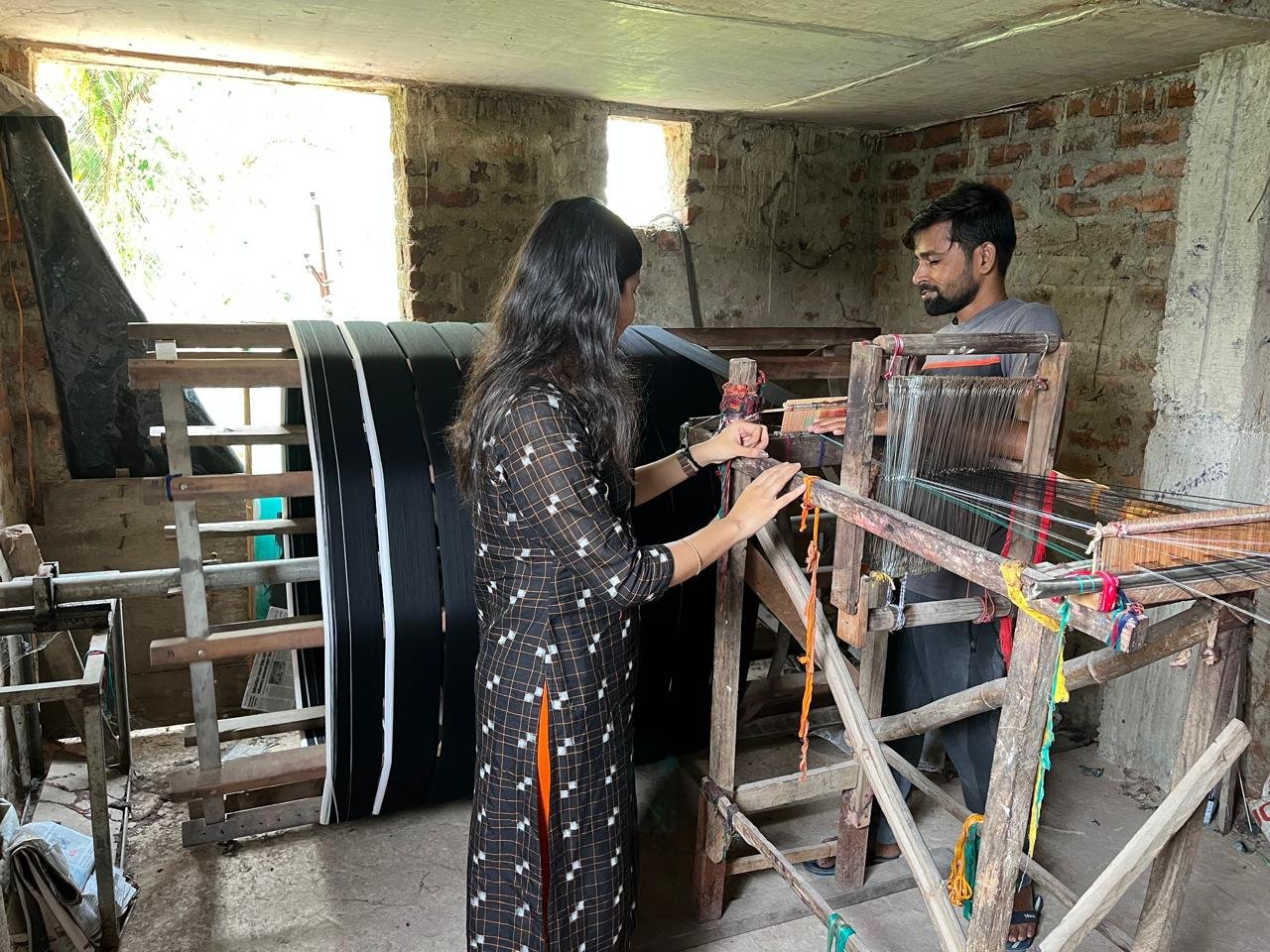
Maniabandha Ikat weaving In the cultural heartland of Odisha’s Cuttack district lies Maniabandha, a village where tradition is not preserved in museums but lived daily through the rhythmic clatter of looms. Here, time is not dictated by modern schedules but by the intricate progression of threads, patterns, and dyes. We witness a community where craftsmanship is not merely an occupation—it is a multi-generational legacy woven into the identity of its people.
Maniabandha stands as one of India’s most historically rich handloom clusters, known for its Bandha (Ikat) weaving technique, a labor-intensive art that transforms raw yarn into textiles of exceptional depth and meaning. Every piece produced here tells a story of discipline, patience, and cultural continuity.
The Soul of Maniabandha Ikat weaving: A Thousand-Year Legacy of Handloom Excellence
We recognize Maniabandha not just as a village, but as a living heritage ecosystem. Historical accounts trace its origins back over a millennium, suggesting that early settlers, possibly influenced by Buddhist principles of non-violence (ahimsa), adopted weaving as a sustainable and ethical livelihood.
This philosophy continues to shape the craft today. Unlike industrial textile production, Maniabandha weaving is deeply human-centered, ensuring that every stage—from yarn preparation to final finishing—is handled with precision and care.
The village’s reputation for excellence is not recent. Historical references indicate that ancient travelers and scholars were captivated by the finesse of its textiles, reinforcing its long-standing global recognition.
Understanding Bandha (Ikat): The Science Behind the Art
To truly grasp the value of Maniabandha textiles, we must understand the Bandha technique, a sophisticated form of Ikat weaving. This method involves pre-dyeing yarns in specific patterns before weaving, ensuring that designs emerge seamlessly during the weaving process.
Step-by-Step Process of Ikat Weaving
- Ikat Classification – Selection of design type and pattern structure
- Scouring – Cleaning raw yarn to remove impurities
- Yarn Preparation – Stretching and aligning threads for uniformity
- Bandha (Tie-Dye) – Tying sections of yarn to resist dye penetration
- Dyeing Process – Applying natural or synthetic dyes in multiple stages
- Drying and Re-Tying – Repeating tie-dye cycles for complex patterns
- Warp and Weft Setting – Aligning threads on the loom
- Weaving – Interlocking warp and weft to reveal the design
- Nali Winding – Preparing bobbins for smooth weaving
- Final Finishing – Washing, polishing, and quality inspection
This process can involve up to 30+ intricate steps, each demanding technical expertise. A single saree may take 15–20 days, while highly detailed designs can extend to two or even three months.
The Artisan’s Perspective: Precision, Patience, and Passion
We observe that Maniabandha’s weavers are not just skilled workers—they are designers, engineers, and storytellers combined. Each artisan must visualize the final pattern before weaving begins, as errors in early stages cannot be corrected later.
This requires:
- Mathematical precision in thread alignment
- Color forecasting during dyeing
- Exceptional hand-eye coordination during weaving
Unlike machine-made fabrics, where patterns are printed or digitally controlled, Maniabandha textiles carry the design within the fabric itself, visible on both sides. This authenticity is a defining feature of genuine handloom.
Economic Reality: Skill Without Structural Support
Despite their unmatched craftsmanship, Maniabandha weavers face a harsh truth: artistic excellence does not guarantee financial stability.
We identify several key challenges:
1. Lack of Market Access
Artisans often rely on intermediaries, reducing their profit margins significantly.
2. Limited Business Knowledge
Weavers specialize in craft, not in pricing strategies, branding, or supply chain management.
3. Competition from Powerlooms
Machine-made imitations flood the market at lower prices, misleading consumers and undermining genuine handloom value.
4. Income Instability
Given the time-intensive nature of production, earnings per piece are disproportionately low compared to effort.
Institutional Support: Bridging the Gap Between Craft and Commerce
We see a gradual transformation driven by organizations and government initiatives aimed at empowering artisans. These efforts focus on:
- Direct-to-consumer platforms
- Skill development programs in business and marketing
- Fair pricing mechanisms
- Promotion of GI (Geographical Indication) tags
Such interventions are critical in ensuring that weavers receive recognition and compensation proportional to their skill.
Cultural Identity: What Makes Maniabandha Unique
While Odisha is home to several renowned weaving traditions, Maniabandha stands apart due to its:
Subtle Aesthetic Language
Unlike bold and vibrant patterns seen in other regions, Maniabandha textiles often feature refined, intricate motifs with balanced color palettes.
Village-Centric Production
The entire ecosystem—from yarn preparation to finishing—is community-driven, ensuring consistency and authenticity.
Deep Symbolism
Patterns often reflect nature, spirituality, and local narratives, making each piece culturally significant.
Handloom vs Powerloom: The Critical Difference
We draw a clear distinction between authentic handloom and machine-made alternatives:
The “soul” of handloom lies in its imperfections, which are not flaws but signatures of human craftsmanship.
Feature
- Production Time
- Design Integrity
- Durability
- Cultural Value
- Uniqueness
Handloom (Maniabandha)
- Weeks to months
- Woven into fabric
- High
- Extremely high
- One-of-a-kind
Powerloom
- Hours to days
- Printed or superficial
- Moderate
- Minimal
- Mass-produced
The Role of Families: Craft as a Collective Effort
In Maniabandha, weaving is not an individual activity—it is a family enterprise. We see:
- Elders guiding design traditions
- Adults managing weaving and dyeing
- Younger members assisting in preparation and finishing
This intergenerational knowledge transfer ensures continuity, but it also raises concerns about sustainability, as younger generations increasingly seek alternative careers.
The Future of Maniabandha: Preservation Through Value Creation
We believe the survival of Maniabandha’s weaving tradition depends on strategic modernization without compromising authenticity.
Key Focus Areas
- Digital Marketing Integration
- E-commerce Expansion
- Brand Positioning as Luxury Handloom
- Consumer Awareness Campaigns
The goal is not just preservation, but elevation of handloom into a premium, globally recognized category.
Why Buying Maniabandha Matters
When we invest in Maniabandha textiles, we are not purchasing fabric—we are supporting:
- Centuries-old craftsmanship
- Sustainable production practices
- Artisan livelihoods
- Cultural heritage preservation
Every purchase directly contributes to keeping this legacy alive.
Conclusion: Threads That Bind Past, Present, and Future
Maniabandha is more than a weaving village—it is a living testament to resilience, artistry, and cultural depth. In a world driven by speed and automation, it stands as a reminder that true value lies in time, effort, and human touch.