

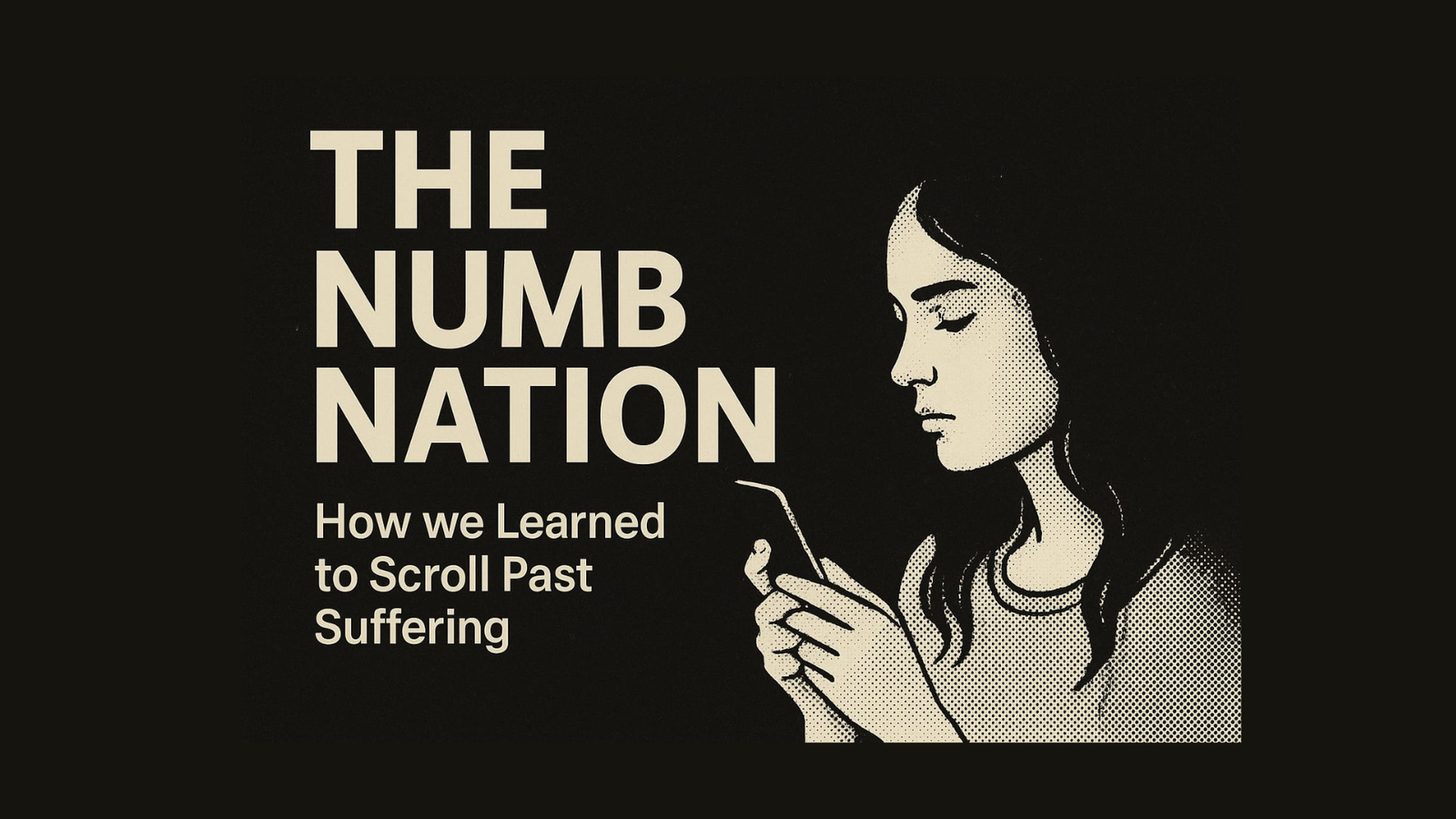
There once was a time when a disturbing photograph on a newspaper’s front page could easily jolt a nation and anger it, for all the right reasons. A single image of a crying child, a fallen soldier, a famine-stricken village, could stir debates in the parliament, provoke protests around the nation or even change foreign policy. But today, contrastingly, we encounter dozens of such images before breakfast, sandwiched between a celebrity’s “Get Ready With Me” reel and a meme about astrology. We double-tap, swipe and keep moving.
We are in an age of relentless witnessing, and paradoxically, one of emotional withdrawal. Violence, tragedy, injustice and disaster are not rare ruptures in our moral consciousness anymore — they are all part of the feed. The extraordinary has become the ordinary. Horror no longer shocks. Outrage no longer mobilises. Empathy, once a catalyst for action, has become emotionally expensive — and we are all subconsciously budgeting.
The numbness is not accidental. It is an adaptation.
The Overexposure Trap
The modern attention economy thrives only on simulation. Every platform, every algorithm, every notification competes for the currency of our focus. In such a non-understandable economy, tragedy becomes content. News organisations, influencers, and political actors understand that pain is clickable — and clickability, in turn, is profitability.
Consider what we are facing currently: a genocide in Gaza, school shootings in the U.S., mob lynchings in India, floods in Bangladesh, rape cases in Delhi, and famine alerts in Sudan.
Yet, all of these are presented in the same scrollable stream — each given mere seconds of attention before the next story elbows its way in. But this is not because we don’t care — it’s because we can’t hold it all.
It is also termed compassion fatigue — the erosion of empathy due to repeated exposure to other people’s pain. It was originally observed in medical workers and humanitarian responders. But now, it is a mass experience. You don’t need to be on the frontline of war to feel emotionally depleted. All you need is a smartphone.
The Rehearsed Outrage Cycle
Our response to anything has become scripted. Something terrible happens, we post, we condemn, we share infographics, we retweet threads, we argue, and then… we move on.
A tragedy used to be a story.
Now, all it is, is a trend.
Once the hashtags stop trending, the suffering continues — but our attention does not. And our attention, unfortunately, is the primary political currency of the digital age. When attention moves on, so does accountability.
The Distance Illusion
One main reason why numbness is so widespread is that we are convinced that suffering belongs elsewhere, to someone else. We scroll past bloodshed in places we have never been to. We see protests in languages we never have spoken. We consume outrage while lying in the comforts of our mattresses.
The screen in front of us creates distance — the world inside our phones isn’t our world. And this distance, creates detachment.
Even when the violence is near, like a hate crime in our city, police brutality in our state, an underfunded hospital in the district — we often treat it with the same distant posture. We respond intellectually instead of viscerally.
It is someone else’s problem, not mine. Not until it occurs to me, at least. We say, “Someone should do something.”
But the someone is always abstract and never ourselves.
The Politics of Numbness
A numbed population is a stabilising force — for power, not democracy. Numbness favours the status quo and doesn’t push for any change or cause imbalances in the supposed equilibrium.
When citizens are emotionally exhausted, they are far less likely to protest. When injustice becomes familiar, institutions are no longer pressured to reform. When suffering becomes normalised, accountability becomes optional.
Governments, corporations, and ideological movements understand this very well. The more we are overwhelmed, the more we retreat into comfort spaces — where denial rules. We retreat into our personal lives — our careers, relationships, hobbies, and our screens.
As long as the public is numbed, policies needn’t change; systemic violence needn’t be addressed; and truth needn’t be protected.
Numbness is not just a psychological condition. It is a political state.
The Apathy of Safety
There is yet another truth that none of us want to hear — we feel safe enough to be numb. We treat suffering like content because we believe it will not happen to us. Our empathy becomes a performance; a way of appearing informed, conscious, and progressive — while staying distant enough to remain unaffected.
It is far easier to mourn abstractly than to risk caring deeply about something. Deep care demands responsibility and threatens convenience. So we choose the easier way out — curated empathy, empathy that is brief, public and cost-free.
The Exhaustion of Caring
To feel, in this era, is labour. Real empathy requires time, emotional investment, and psychological vulnerability. And many of us are just tired — tired from work, from burnout, from capitalism and from the pace at which everything runs.
Caring deeply about one issue is overwhelming, and caring about all of them seems impossible. The result is a selective shutdown — not because we are inhuman, but because we are overwhelmed humans.
The Return to Small Human-ness
So what do we do?
We cannot force ourselves to feel everything. That will not be empathy — that will be emotional collapse. But we can resist the side of ourselves that slides into numbness by recovering the scale of the human.
Care needn’t be global. It can be local. Justice does not happen only in courts — it happens in daily choices. And empathy, it needn’t be loud — it just needs to be consistent.
Listening when someone is vulnerable, refusing to laugh at cruelty disguised as humour, interrupting prejudice in a room where no one is recording, learning before sharing, helping someone we know — all of these are acts of empathy.
Large-scale suffering is overwhelming. But individual dignity is always understandable. We can learn to sit with discomfort rather than scroll past it. To not look away the moment something feels heavy is also something possible. To allow ourselves to be affected is also something possible.
Because numbness is not neutral. It is the slow erosion of our humanity.
Why Feeling Still Matters
The world changes only when people feel something strongly enough to act. Every movement — civil rights, feminism, queer liberation, anti-war protests — began not from statistics or headlines but from felt urgency.
Feeling is not weakness or naïve. It is political.
And the moment we stop feeling, we stop being citizens; we become spectators.