

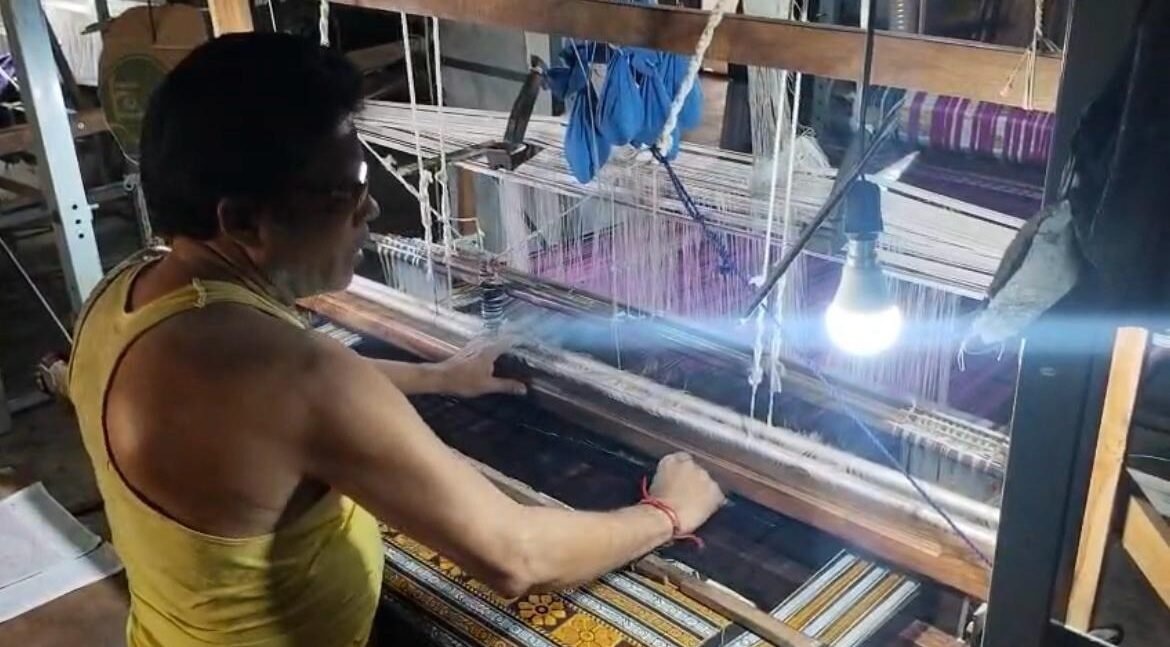
The Fading Echo of a Timeless Craft
In the quiet village of chicheiguda, the rhythmic clatter of wooden looms once defined daily life. Today, that sound is fading. What was once a thriving ecosystem of skilled artisans has been reduced to a fragile remnant struggling to survive. We explore not just a craft, but a civilizational legacy rooted in precision, identity, and generational knowledge.
The Bhulia community, historically known for its intricate handloom weaving, now stands at a crossroads. Their story is not just about economic hardship—it is about the erosion of cultural identity, systemic neglect, and a rapidly changing market that no longer values patience and craftsmanship.
The Bhulia Weaving Tradition: A Mathematical Art Form
At the core of this tradition lies a deeply intellectual and artistic process. Weaving, for the Bhulia artisans, is not mechanical labor—it is a structured, almost mathematical discipline.
Every saree begins as a concept. The artisan drafts the design on paper, mapping out patterns with geometric precision and symbolic intent. Each thread is calculated. Each motif carries meaning. This is not random creativity; it is controlled artistry governed by experience and mental calculation.
The loom becomes an instrument, and the weaver, a composer. The resulting textile is not just fabric—it is a coded narrative woven through warp and weft.
Shri Hare Meher: The Last Guardian of the Loom
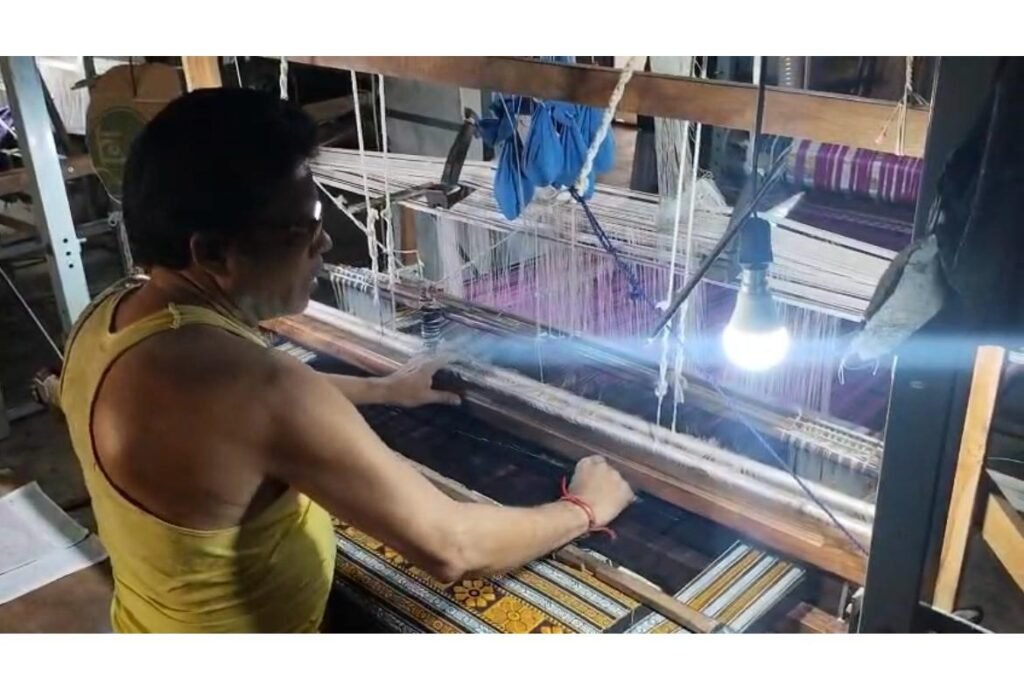
Among the few remaining artisans, Shri Hare Meher represents the resilience of tradition in the face of collapse. Having started weaving at seventeen under difficult circumstances, his journey reflects necessity turning into mastery.
He does not romanticize the craft. He understands its declining relevance in modern markets. Yet, he continues—not out of compulsion, but out of conviction. For him, weaving is identity.
His skill allows him to earn significantly more than others, sometimes reaching ₹2,000 per day, but this is not the norm. It is an exception built on decades of expertise. The average weaver does not share this stability, which reveals a critical imbalance within the ecosystem.
The Collapse Of The Chicheiguda Weavers’ Cooperative
Once a hub of activity with over a hundred weavers, the chicheiguda Weavers’ Cooperative Society is now nearly defunct. Only a handful of artisans remain.
The reasons are not abstract—they are painfully practical:
- Severe lack of infrastructure: Poor lighting and ventilation make working conditions physically damaging.
- Supply chain inefficiencies: Yarn must be sourced from distant locations, increasing costs and delays.
- Unfair compensation structures: A saree that takes an entire week to produce earns roughly ₹700, which is economically unsustainable.
- Market disconnect: There is no structured demand pipeline or consistent buyer network.
This is not decline—it is systemic failure.
Economic Reality: Why Weaving Is No Longer Viable
The harsh truth is simple: weaving does not pay enough to survive.
Younger generations are not abandoning tradition out of ignorance—they are making rational decisions. When a week’s labor yields less than what can be earned in a day through other work, the choice becomes obvious.
Even government interventions, such as stipends and training programs, fail to retain talent. These initiatives address entry but ignore long-term income sustainability, which is the real problem.
Without consistent income, no craft—no matter how culturally significant—can survive.
The Digital Gap: Missing the Modern Marketplace
One of the most critical failures is the absence of digital integration. The Bhulia weavers of Chicheiguda are largely disconnected from:
- E-commerce platforms
- Direct-to-consumer marketing
- Global artisan marketplaces
This isolation ensures that their products never reach audiences willing to pay premium prices for handcrafted goods.
Meanwhile, machine-made replicas dominate online platforms, offering cheaper alternatives that dilute the perceived value of authentic handloom products.
Without digital presence, visibility drops to zero—and with it, demand disappears.
The Gender Imbalance: An Untapped Workforce
In many parts of Odisha, women have become central to handloom revival efforts. In Chicheiguda, however, their participation remains minimal.
This is a strategic failure.
Involving women could:
- Increase production capacity
- Introduce design innovation
- Strengthen household-level economic resilience
Ignoring half the population in a declining industry is not just inefficient—it accelerates collapse.
Habaspuri Sarees: A Dying Masterpiece
Among the most iconic outputs of this tradition is the Habaspuri saree—a textile known for its intricate motifs, symbolic storytelling, and cultural depth.
These sarees are not mass products. They are time-intensive, skill-dependent creations that carry historical narratives.
Yet, demand has sharply declined.
Why?
- Changing consumer preferences toward fast fashion
- Lack of branding and storytelling in marketing
- Absence of premium positioning in urban markets
The problem is not the product—it is the failure to position it correctly.
Market Failure: The Real Reason Behind the Decline
Let’s be direct: the decline of Chicheiguda’s weaving tradition is not because people don’t value craftsmanship. It is because the system has failed to connect value with visibility.
Consumers are willing to pay for authenticity—but only when:
- They understand the story
- They trust the source
- They perceive exclusivity
None of this is being communicated effectively.
The weavers are producing high-value goods, but selling them in a low-value ecosystem.
That mismatch is killing the industry.
What Needs to Change Immediately
If survival is the goal, incremental changes won’t work. Structural shifts are required:
1. Direct Market Access
We must eliminate middlemen and connect weavers directly to buyers through online platforms and curated marketplaces.
2. Premium Branding
Habaspuri sarees should not compete with cheap textiles. They must be positioned as luxury heritage products.
3. Design Evolution
Traditional motifs should be preserved, but formats must adapt—introducing modern color palettes and wearable variations.
4. Skill Monetization
Experienced artisans like Shri Hare Meher should be leveraged as trainers and brand ambassadors, not just laborers.
5. Women’s Inclusion
Scaling production without involving women is unrealistic. Their inclusion is not optional—it is necessary.
The Cultural Cost of Losing the Loom
If the looms of Chicheiguda fall silent, the loss will not be limited to textiles. It will mean the disappearance of:
- A knowledge system built over generations
- A community’s identity and pride
- A unique artistic language that cannot be replicated by machines
This is not nostalgia. This is irreversible damage.
You can rebuild infrastructure. You cannot recreate lost heritage.
Conclusion: The Final Thread Holding Everything Together
The story of Chicheiguda is not unique—but it is urgent. It reflects a broader pattern where traditional industries collapse under modern economic pressures without strategic adaptation.
Shri Hare Meher continues to weave—not because the system supports him, but because he refuses to let it die.