

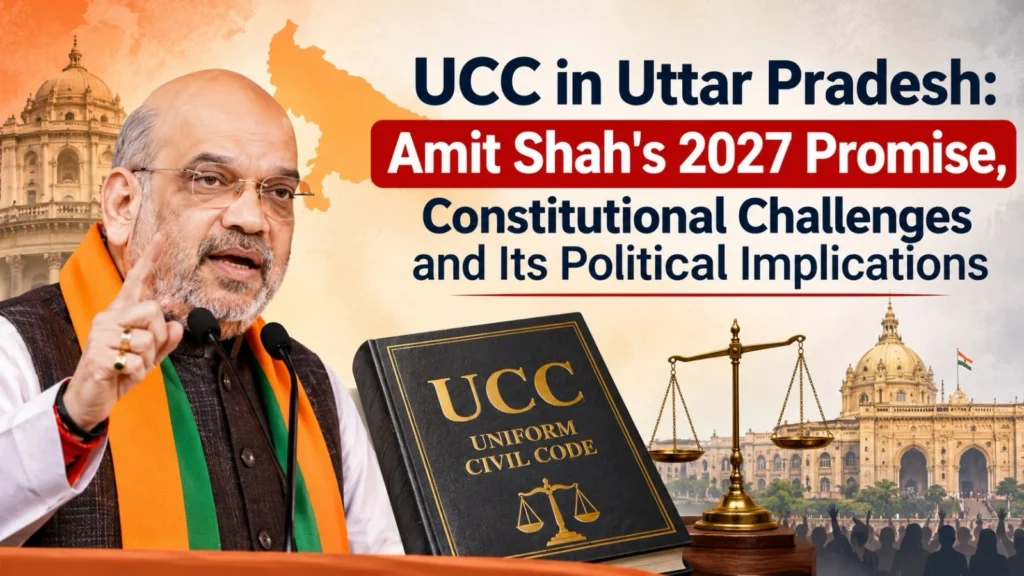
Amit Shah’s recent promise to bring the Uniform Civil Code (UCC) to Uttar Pradesh has thrown the issue back into the spotlight. At a BJP meeting in Lucknow, he said, if the party wins 2027 Assembly elections, they will push for a single civil law across the state. Suddenly, UCC came right at the heart of UP’s political chatter. This is not just another campaign slogan; it needs larger introspection. Rolling out the UCC in a state as big and complex as UP isn’t simple it raises tough legal, social, and administrative questions.
What Does UCC Mean for Uttar Pradesh?
It is a plan to create one set of civil laws for everyone, covering things like marriage, divorce, inheritance, succession, and adoption, regardless of your religion. At present, people follow different personal laws based on their faith in matters of marriage, inheritance, etc. The push for UCC goes back to Article 44 in the Constitution, which nudges the state to try for a uniform civil code. But that is tucked into the Directive Principles section, which is not directly enforceable in court.
There’s a recent precedent: Uttarakhand actually enacted its own UCC, and that law takes effect from January 2025. UP could look to Uttarakhand for ideas, but the scale here is way bigger and there’s a lot more social variety to deal with.
Why Is the UCC Announcement Politically Significant?
Timing, certainly is the most important aspect here. With the 2027 elections looming, Amit Shah’s pitch is not just about legal reform it is a play to set the agenda and spark debate. The BJP has always kept UCC high on its ideological wish list, and now they are ramping up the conversation. To their supporters, it is about fairness one law for all, especially around women’s rights in family matters. But the story does not end with the BJP. Opposition parties like the Samajwadi Party and Congress won’t just shrug this off. They will likely challenge the UCC idea from angles like minority rights, constitutional guarantees, and the messy realities of putting these laws into practice. Expect it to become a battleground issue.
How Could UCC Influence Voters in Uttar Pradesh?
The UCC does not lock everyone into one reaction. Supporters see it as a move toward equality, especially for women’s rights in marriage and inheritance. But plenty of religious minorities are worried, saying their traditions and freedoms could get steamrolled. The Muslim community in UP is huge, so their concerns could shape how the debate plays out. People are asking if the law can really protect cultural diversity along with equal rights. There’s another layer UP politics is famous for caste alliances and social justice debates. UCC might shake up the usual mix by introducing questions over uniformity and religious identity. Still, it’s not wise to think UCC will be the only thing voters care about. Jobs, inflation, farming, law and order, education all those issues still matter.
Constitutional and Legal Challenges Before Implementation
To pass a UCC, UP would have to make sure the law is in line with the Constitution. Article 44 gives some direction, but they also have to stick to key rights like equality (Article 14) and religious freedom (Articles 25 and 26). Changing these personal laws means rethinking deep-rooted traditions in marriage, adoption, and inheritance. The goal would be gender equality without stomping on rights protected elsewhere.
UP’s size and diversity make things complicated. Would the law recognize tribal customs or carve out exceptions the way Uttarakhand did? Scheduled Tribes got exemptions there, so should UP do the same? And with civil matters on the Concurrent List, both state and Parliament have a say. If UP’s UCC clashes with national laws, it might need the President’s nod.
One more thing UP’s State Law Commission still hadn’t started drafting a UCC as of September 2026, so the timeline and process are up in the air.
The Road Ahead: UCC and the 2027 UP Assembly Elections
Looking ahead, Shah’s promise guarantees UCC will be a headline issue as the 2027 elections approach. Whether it becomes the main fight depends on how the parties—and voters—take it up. For the BJP, this is a way to keep a core promise alive. For the opposition, it’s a chance to press on rights, consultations, and balancing uniformity with diversity. But here’s what really matters: beyond the speeches and campaign signs, the substance of the law will decide its fate—how well it protects rights, stands up constitutionally, and actually delivers some equality in daily life. As UP heads toward the elections, people will not just ask if a Uniform Civil Code is coming. The real questions are what shape it will take, whose rights it will serve, and how it might change the landscape of law, society, and politics in the state.

Comments