

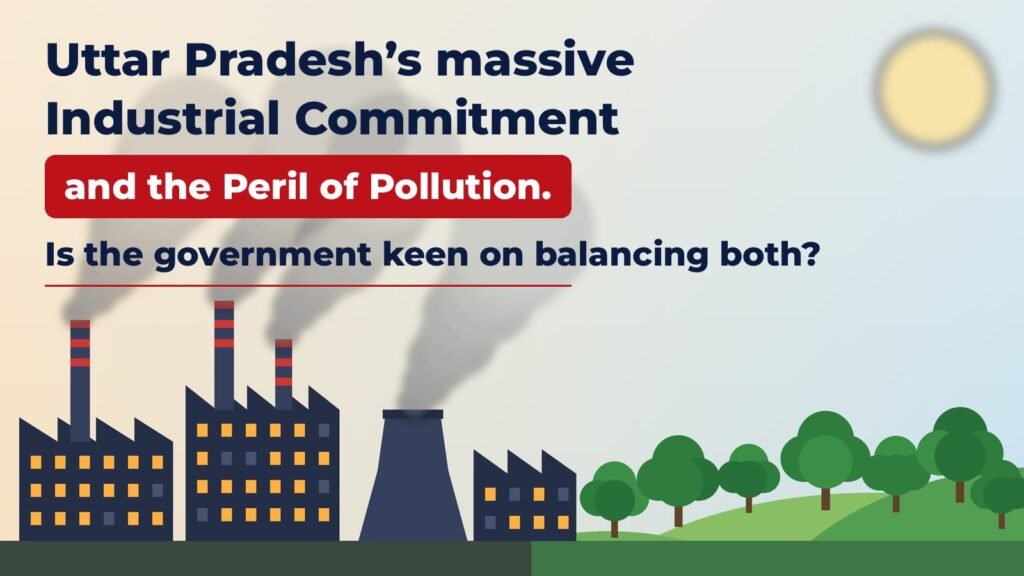
Uttar Pradesh is going full speed ahead on the industrial front—factories popping up, big investments rolling in, and ambitions set high. But there’s a problem lurking underneath all that growth: pollution. With new factories come higher risks to air and water, and the question is, who’s actually making sure things don’t get out of hand?
The government definitely wants UP to shine as one of India’s top industrial states. Manufacturing and new investment zones make the headlines and promise jobs and revenue. But protecting the environment shouldn’t just be a box to tick on a development plan. It has to be part of the deal.
Factories are a huge source of pollution. They spit out particles and toxic gases. Places like Kanpur, Unnao, Moradabad, Firozabad, Ghaziabad, and Noida—these aren’t just manufacturing powerhouses, they’re also hotspots for industrial waste. Chemicals, dyes, heavy metals, all kinds of stuff end up in drains, rivers, or even seeping down to the groundwater. When waste isn’t treated—and often, it isn’t—it goes straight into the environment. The government knows about this. The Central Pollution Control Board (CPCB) has listed 13 industrial areas in UP as polluted, and of those, nine are in the “critically polluted” red zone. Kanpur, Mathura, Moradabad, Ghaziabad, Agra, Firozabad, Gajraula, Varanasi-Mirzapur, Bulandshahr-Khurja—these places are feeling the strain, with air and water quality paying the price.
The Hindon River Case
Take the Hindon River, just as one example. It twists through the western part of the state, but instead of just being a scenic river, it’s turned into a dumping channel. A recent investigation found that over 350 industries pour more than 72 million litres of waste into the Hindon every single day. On top of that, households dump almost a billion litres of sewage daily. Think about that kind of volume. It’s staggering.
And it’s not just the Hindon. Its tributaries, like the Kali West and Krishni, are suffering too. The National Green Tribunal (NGT) keeps pointing out the pollution problems—untreated wastewater, industrial discharge, and delays in cleaning up. For all the talk about effluent treatment plants (the big units meant to clean industrial water before it hits rivers), the reality is rougher on the ground. Unless equipment is actually used and monitored, and unless factories are held accountable, the pollution keeps coming.
Is Monitoring keeping pace with the industrialisation?
UP’s Pollution Control Board says it is. There are online portals, digital dashboards, and monitoring systems. On paper, more than 85,000 industries are registered, with about 70,000 operational. The board tracks inspections, pollution reports, all that. High-pollution industries like tanneries, sugar mills, pharmaceutical plants—they’re watched. But there’s a big gap between paperwork and action. Just because a factory shows up on a portal doesn’t mean its treatment plant is working. Common effluent treatment plants (CETPs)—the shared cleaning facilities—are often struggling. Of the ten CETPs listed for the Ganga basin, seven are working, three are marked as defunct. In Kanpur and Unnao, there are issues with connecting tanneries to pipelines. Bhadohi, Moradabad, and Jainpur’s facilities are simply not working. So where does all the waste go? Probably right where it shouldn’t.
The Government’s endeavours: Inspections, monitoring and actions
The government is not ignoring the issue. They do inspections. The Environment Minister, during first assembly session in 2026, told the Assembly that they checked more than 1,800 heavy polluters last year and found about 1,350 following the rules. They’ve issued closure orders, put in place online monitoring systems, and forced industries to pay for their own water treatment setups. There are wider plans too—improving air in 17 of the worst-affected cities, mapping polluted rivers, and putting environmental committees in charge of river clean-up efforts. Some cities have seen improvements in particulate pollution. That’s good news.
Industrial development needs cleaner practices, not just bigger investments
Enforcement only works if it keeps biting. News reports keep coming out—factories shut down in Noida and Ghaziabad for violating the rules, bringing up worries about what gets dumped into the ground and water. The numbers also raise eyebrows. Out of those 1,800 big polluters, over 450 were not following standards. What happened next? Did they fix up, or did the problems just go underground until the next inspection?
Closing a polluting factory is only half the battle. What if it quietly restarts without fixing anything? Connecting an industry to a CETP is pointless if that CETP is not actually treating the waste properly. Installing equipment is not the same as using it.
If UP wants to be India’s next industrial powerhouse, it needs cleaner practices, not just new factories. The state needs to go beyond launching new inspection portals or shutting plants for show. CETPs need to be up and running, not just listed on dashboards. Factories should not just buy compliance; they should prove it every day.
And the public deserves more information. Water quality data, inspection results, fines, and records on repeat offenders should all be easy to find. This will build trust and accountability starts. It is not just about how many factories open or how much money flows in. The real measure of success will be if UP can bring in all that investment—but keep its rivers, air, and soil safe for the people who call the state home. That is when growth really counts.



Comments