
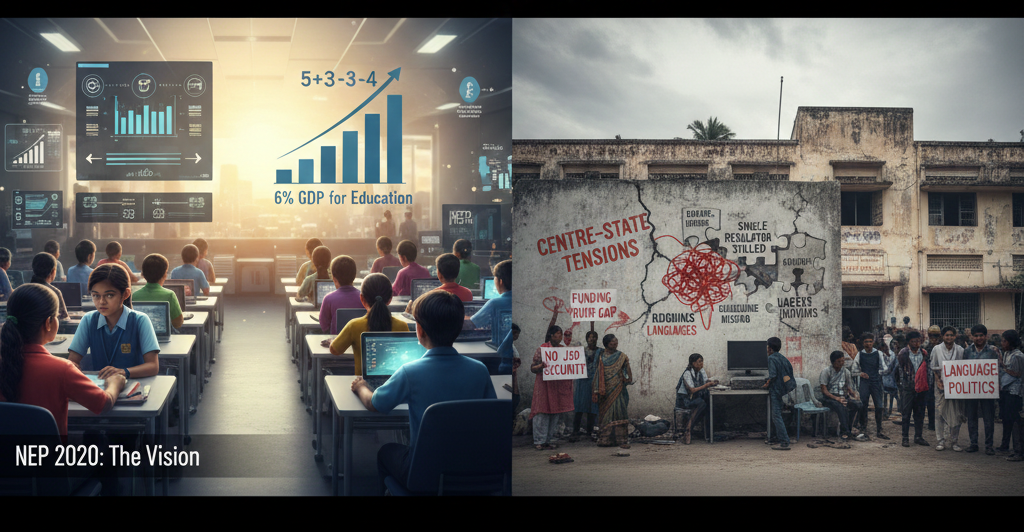

When the Union government unveiled NEP 2020 it framed the document as the most ambitious overhaul of Indian education in decades. A new school structure (5+3+3+4), universal foundational literacy goals, sweeping curriculum reforms, and an entirely reimagined higher education ecosystem were among its promises.
Five years later, NEP is more visible on paper than on the ground. While some of the pieces are being rolled out, large parts remain stalled, contested, or unevenly adopted across states.2 How to make sense of this requires sifting through the divide between central intent, state autonomy, fiscal realities, and political disagreements.
What NEP Envisions: The Core Reforms
NEP 2020 lays out a long list of goals that reshape the entire schooling and higher-education pipeline:3
New School Structure
It rejects the traditional 10+2 model and follows a 5+3+3+4 structure that aligns with early childhood care and education, middle stages, and secondary schooling to cognitive development.
Strong Emphasis on Foundational Learning
Achieving Universal foundational literacy and numeracy by Class 3 is one of the non-negotiables of NEP.5 This includes expansions of Balvatika, early childhood classrooms, and Anganwadi strengthening.
Transition to Competency-Based Learning
It is expected that the boards and schools will reduce rote learning, inculcate critical thinking, and redesign assessments accordingly.
Multidisciplinary Higher Education
A complete restructuring of undergraduate degrees into flexible, multidisciplinary formats, with multiple entry–exit options.
Single Regulator for Higher Education
NEP proposes replacing bodies like UGC and AICTE with a single regulator often referred to as the HECI or the Higher Education Commission of India
Higher Education Budgets
The policy targets 6% of GDP for education [A link to recent official data/analysis showing India’s current education spending as a percentage of GDP]—something India has never achieved.

What Really Took Place: Recent Events
Despite the slow pace, different components of NEP have moved ahead in pockets.10
CBSE and National Boards Move towards Skill-Based Learning
CBSE has started shifting the curriculum at the middle-school level to skill-based and competency-driven frameworks. The skill subjects are being expanded in Classes 6–8, and board exams have been reoriented toward application-based questions.
State-Level Adoption w/ Local Modifications
States decide whether and how NEP is adopted. Consequently:
While Maharashtra approved the NEP-linked reforms, it added its own twist by making Hindi a compulsory third language, which generated a lot of debate.
While Karnataka and Madhya Pradesh have been relatively proactive in piloting Balvatika classes and modular vocational components,
Several northeastern states have implemented foundational reforms through central schemes aligned with NEP.
Slow Progress on Higher Education Regulation
The concept of a single regulator is still debated, with no legislation passed. Several rounds of consultation have been held, but a consensus has eluded the ministries and the regulatory bodies.
Teacher Training and EdTech Pilots
Pilot runs of teacher-training modules matched to competency outcomes of the NEP have been held in several states. States have also tested digital learning platforms, although access inequalities persist.
The Controversies: Why NEP Has Triggered Resistance
NEP has been caught up in innumerable political and ideological debates.
Centre–State Tensions
Education is a concurrent list subject, meaning responsibility is shared between states.11 NEP itself is a policy and not a law.
States like Tamil Nadu, Kerala, West Bengal, and Telangana oppose several aspects:
the three-language formula
perceived centralisation
proposals for common assessments or entry tests
The unified regulator of higher education14
This has resulted in partial or non-implementation in many regions.
Fears of Privatisation
Teacher unions and education activists argue NEP strengths:
Public–private partnerships
Private involvement in early childhood and vocational training
Market-driven higher education models
This has led to widespread protests in many states and the issuance of parallel education policies by civil-society groups.
Language Politics
NEP recommends mother-tongue instruction in early grades and promotes the three-language formula.15
However, non-Hindi-speaking states fear that
implicit promotion of Hindi
erosion of regional languages
reduced state autonomy in curriculum decisions
The Hindi mandate in Maharashtra and other similar moves elsewhere have intensified linguistic debates.
Mergers and Closures of Schools
This has engendered opposition in states that have been implementing NEP-aligned policies of “school consolidation”.
For example, Karnataka’s plan to merge government schools into larger “magnet schools” triggered protests citing
longer travel distances
risk of increased dropouts
reduced access for rural, tribal and marginalised students
Why NEP Has Not Been Fully Implemented Yet
The policy is ambitious, but the ground realities are demanding. The major blockers would fall under four categories.
Funding Gap
NEP mandates a spending of 6% of the GDP on education.18 As things stand, India is spending around 3%, while most state budgets provide for even less.
Successful implementation requires funds for:
teacher hiring
training programmes
digital infrastructure
Balvatika and ECCE expansion
new curricular resources
Upgraded Labs and Vocational Spaces
Reforms remain aspirational without sustained funding.20
Teacher Shortages and Capacity Issues
Many states face:
massive teacher vacancies
frozen recruitment cycles
limited teacher-education institutions
outdated training models
Indeed, NEP’s recommendations-competency-based classrooms, foundational literacy missions, multidisciplinary teaching-require more and better-trained teachers, not fewer.
Administrative Delays and Lack of Clear Operational Guidelines
NEP is a blueprint, not an implementation manual.
States still do not have specific guidelines on the following:
Assessment redesign
teacher-training curriculum
FLN monitoring
higher-education structure revisions
timelines and evaluation metrics
Without official regulations, states have drawn up their own versions of rules at their own pace.
Political and Stakeholder Resistance
Many groups are reluctant:
Teachers’ associations oppose frequent changes in curriculum and express apprehension regarding job insecurity.
State governments are opposed to perceived centralisation.
Students and activists oppose privatisation and language mandates.
Universities are uncertain about restructuring degrees and credit frameworks.
Instead of an aggressive nationwide rollout, governments have adopted incremental state-by-state approaches, slowing the entire process.
What Implementation Looks Like Today
Five years into NEP, the landscape is mixed:
Foundational reforms are the most visible
Piloting of Balvatika, FLN programmes, and early-grade reading improvements have commenced in several states.
Curriculum changes are happening but unevenly
Central boards have taken the lead. State boards are moving more slowly because of costs, training requirements, and political differences.
Reforms in higher education are fragmented
Some have adopted the four-year degree with multiple exits; others continue older systems. The overhaul of regulations remains incomplete.
Lingering mistrust slows adoption
The states that distrust the motives of the central government implement selectively or not at all.
Private schools are leading and outshine government schools.
Private institutions have managed to implement competency-based learning faster because of better resources, hence increasing inequality gaps.
Conclusion: NEP’s Promise vs. Reality
NEP 2020 is one of India’s most ambitious education reform documents. It has:
shifted national conversation toward foundational literacy.
Influenced curriculum innovations,
pushed universities to reconsider the degree structures.
and encouraged policy experimentation at state level.
But it has not yet transformed the education system in the way originally promised—and the reasons are structural. Without: predictable funding, extensive teacher recruitment and training, clear implementation guidelines, political consensus, sensitive handling of language and federal concerns, and NEP will remain a long-term vision, not a concrete reform at the national level. For the time being, NEP thus represents an uneven, contested, and highly state-dependent process whose future direction is uncertain.