

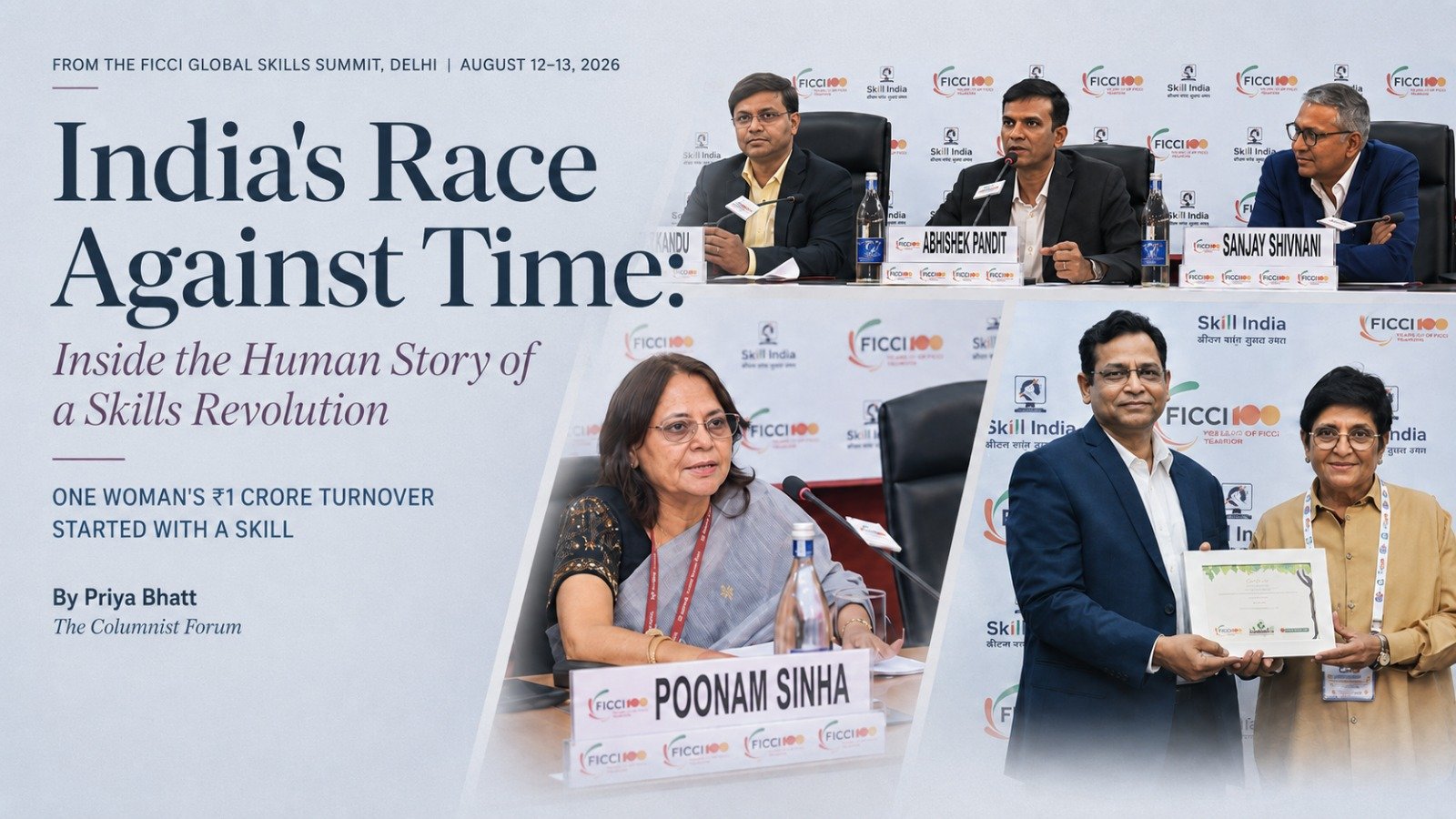
India is investing ₹60,000 crore to bet big on its youth, believing its talent pipeline can meet global demand if the training system keeps pace. That was the message at the 17 th FICCI Global Skills Summit (August 12-13, Delhi), where the Prime Minister’s Skill Upgradation and Training Utilisation (PM-SETU) scheme, with World Bank and ADB support, got a hearing. The plan to upskill 1,000 Industrial Training Institutes (ITIs) through a hub-and-spoke model – connecting these institutes with better-equipped labs as ‘hubs’ is already underway. Honda’s Horsepower Motor Scooter India (HMSI) has been running a 3-week industry immersion programme for ITI teachers.
“The theme – Skills for Intelligent Age: Expanding Pathways, Shaping Possibilities”, said delegates gathered at the summit to discuss ways India can position itself as the global talent destination ahead of the demographic dividend peak, “reflects the sense of urgency”. They added, “India must move from just skilling to certifying competencies – demand-driven.”
Dr. Kiran Bedi, chairperson of the National Crime Records Bureau and a former Union police commissioner, spoke passionately about time: India’s youth dividend is a time-bound opportunity. It’s time-bound; it’s not time-flexible. The dividend will not convert into growth by itself. We need collaborative execution, collaborative, all of us… collaborative execution, not only intent. You’ve begun with the intent; collaborative execution is the real challenge.
These words ran through the two-day summit, where delegates and panellists from the government, industry, and academia deliberated across six themes, including the prime minister’s PM-SETU.
GCCs: Beyond Cost Cutters and Nearshoring
India’s Global Capability Centres (GCCs) have transcended their image as mere back-office outsourcing destinations. With a presence in 38 countries, India’s GCCs employ 2.36 million people and clocked $98.4 billion in FY26.
But 62% of GCC executives surveyed say there is a shortage of composite talent, and 45% will require upskilling in the next 3 years. In addition, just 27% of GCC leaders feel confident about their AI literacy, on average, and those with lower proficiency levels are likely to see up to 19.32% of their projected $98.4 billion value at risk by 2030 if they fail to develop these competencies.
AI Won’t Steal Your Job – Unless You’re Sleeping on the Job
India is doubling down on human-AI collaboration, with robots handling rule-based tasks and humans bringing empathy and judgement to the fore, say reports presented at the summit. FICCI and KPMG India recently released a white paper on the implications of generative AI, while the government’s Skilling Organisation for AI Readiness (SOAR) has already enrolled over 2.10 lakh students in its upskilling programmes by mid-2026. These initiatives are beginning to bear fruit, with students from tier-2 and tier-3 districts being particularly vocal about their interest in jobs in AI.
Global demand for talent is meeting local supply constraints – What will India do?
Japan, for instance, needs 600,000 AI and blockchain-ready workers, and other nations are set to follow suit. To meet the global need, experts proposed a 5P mobility framework – Predict, Prepare, Passport, Place, and Protect – for skilling and reskilling millions of workers in emerging technologies. Language training is also critical for international assignments, with proficiency in B2-level German being a must for candidates considering overseas opportunities. Furthermore, government-to-government conversations with 21-22 countries are already underway to recognise Indian qualifications, with NOCN and Highfield certification and accreditation bodies also in talks to bring Indian qualifications in line with international standards.
Workplace Experience Beats Classroom Learning, Say Employers and Trainees Alike
India needs to think of “workplace education”, said panellists, recommending that apprenticeships see workers spend 70% of their time in companies as is the case in Switzerland and Germany. These countries’ vocational education and training systems provide high-quality skills by embedding students directly in firms. Small and medium-sized enterprises (MSMEs) are natural partners in this strategy, as they contribute to 39% of India’s GDP but are underserved by skilling initiatives due to compliance challenges. Delegates proposed setting up ‘cluster-based’ hub facilities to bring advanced training within reach. Additionally, panellists proposed a UK-style levy – a tax on skills used in production – to finance skills development, rather than relying solely on the Union budget. Many delegates also pointed to the success of NAPS, a flagship apprenticeship initiative in India that has enrolled over 6 lakh apprentices to date.
Skills for the ‘Green’ Economy Are In Demand – Even if You’re Not an Environmentalist
Every occupation now has a “green quotient”, from finance managers needing to understand green bonds to logistics executives optimising transportation to reduce carbon footprints. India’s electric vehicle (EV) revolution, for instance, is set to create 10 million jobs by 2030. One of the most heartening stories at the summit was about young women from salt pan families in Gujarat who were trained in solar power and ended up launching their own enterprises, with one woman recording a turnover of ₹1 crore last year.
Conclusion
₹60,000 crore, 1,000 ITIs, six converging themes – FICCI GSS 2026 left delegates with no doubt that India is serious about skilling millions of workers to meet domestic and global demand. However, the success of all these efforts will depend on whether India can rise to the collaborative execution challenge, said Dr. Bedi during her keynote speech. Every theme at the summit – from PM-SETU’s ITI upgrades to GCCs upskilling and apprenticeships in the works – pointed to this fundamental truth.