
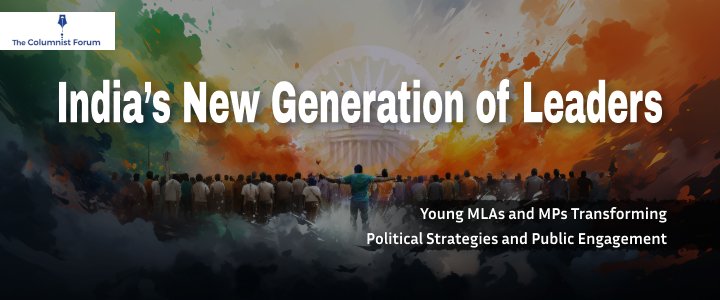

With the generational shift in Indian politics, the rise of young MLAs and MPs has become one of the most noticeable trends in the past ten years. Their presence is reshaping how campaigns are run, how citizens engage with representatives, and how political discourse unfolds online and offline.
With parties across ideologies—from the Congress to the BJP, AAP, DMK, TMC, and regional outfits pushing forward younger leaders, demographic realities, digital culture, and changing voter expectations have all combined to herald a new era in India’s political landscape.

A New Generation Steps In
With a median age of about 29 years, India is one of the youngest countries in the world First-time voters, youthful job seekers, and digital natives now make up a decisive bloc that political parties can no longer afford to ignore. That is why a number of young leaders have been coming into state assemblies and Parliament, often as a result of a mix of family legacies, grassroots activism, or strategic party grooming.
For instance, over 12% of MPs in the 17th Lok Sabha were below the age of 40-years marking a small but steady increase. The state assemblies of Delhi, Punjab, Tamil Nadu, Maharashtra, and Karnataka have also seen an increase in MLAs below 40-years. Many such young leaders focus on hyper-local governance, digital transparency, and policies that are focused on youth aspirations—issues usually overshadowed by traditional caste and community politics.
Why Parties Are Betting on Young Politicians
Demographic Pressure
With millions of new voters coming on to the rolls every year parties know that a young, relatable representative can help tap into a politically restless but under-engaged demographic.
Digital Savviness
Young leaders have fluency with technology, meaning parties can now run leaner, faster, and more targeted campaigns. They are as comfortable giving a press bite as they are going live on Instagram.
Shifting Voting Behaviour
Indeed, many urban and semi-urban voters have started assessing MLAs and MPs based on work, visibility, and accessibility rather than mere party loyalty. Younger representatives often build this visibility by quicker response cycles, data-based reporting, and regular digital engagement.
Rebranding Political Parties
The promotion of young leaders serves as a strategic branding exercise for parties seeking to project themselves as modernizing forces. Youth faces usually act as bridges between the old guard and the new constituencies.
New Styles of Constituency Politics
The most significant difference that young MLAs and MPs have brought about is in constituency management. Their method usually consists of:
Data-Driven Governance
Many of them rely on ward-level surveys, grievance-mapping apps, and digital dashboards to keep track of public needs and government scheme delivery. This contrasts heavily with earlier informal or patronage-based models.
Accessibility Through Social Media
WhatsApp groups, Telegram channels, X updates, and Instagram reels are becoming political offices in their own right. Very often, the responses come in hours, not weeks.
Professionalized Teams
A new political infrastructure has emerged—teams of young policy researchers, digital managers, legal advisors, and campaign strategists. For many of them, it is like a startup and not a conventional political outfit.
Hyper-Local Issue Prioritisation
Instead of broad ideological messaging, young MLAs and MPs stress:
pothole fixing
water supply
waste management
employment fairs
women’s safety
Youth Skilling Programmes
This helps them establish credibility at the grassroots level.
How Young Leaders Are Transforming Campaigns
The Main Area of Social Media
Campaigns now rely on Instagram reels, memes, YouTube explainer videos, and short-format political storytelling that is intentionally devised for virality. Many young politicians make use of:
Instagram Lives for instant Q&A
Twitter Spaces for public discussions
Reels/TikTok-style videos, in states where platforms are active
Consistent branding with colors, slogans, and digital aesthetics
This produces a direct, unfiltered line to the voters, particularly first-time voters.
Micro-Targeting via Data Analytics
Just like startups, young candidates use voter-segment databases to tailor messaging:
job seekers
women commuters
migrant laborers
college students
farmers in peri-urban belts
Campaigns are no longer one-size-fits-all.
Collaborations With Influencers
Social media influencers, especially local language creators, have become powerful amplifiers. Young MLAs and MPs regularly work together on campaign videos, town halls, and issue-based outreach.
Volunteer-Based Street Movements
Volunteer armies, often mobilized through Instagram and college networks, play an active role. This trend was popularised by newer parties, and now it has also been replicated by the mainstream parties.
Policy Priorities: What Young Politicians Bring to the Table
Younger leaders tend to focus on topics often overlooked by previous, older political leadership.
Youth Employment & Skilling
With unemployment a top concern, young MLAs and MPs push for:
local job fairs
skill-training centres
Entrepreneurship Support
digital literacy camps
Their policies often reflect first-hand understanding of youth frustrations.
Modernization of Public Infrastructure
They call for:
pedestrian-friendly streets
Women’s safety infrastructure
better public transport
tech-led grievance redressal
These issues appeal to urban and semi-urban youth.
Mental Health & Education Reform
A growing number of younger politicians underlines:
Coaching-centre stress
student suicides
fee regulation
student housing concerns
These themes rarely appeared in earlier political narratives.
Gender and Inclusivity Issues
Young women MLAs and MPs are particularly vocal on:
Workplace harassment
menstrual hygiene
representation in local governance
crime reporting systems
Challenges and Criticisms
Despite their rise, young politicians face significant hurdles.
Dynastic Dominance
Many young MLAs and MPs belong to political families. Critics claim that while they are young, they hardly represent the common youth aspirations.
Overdependence on Social Media
Some are accused of prioritizing online image-building over ground work. Their critics call them “Instagram politicians”.
Resistance from Older Party Structures
They often have to work with entrenched hierarchies, especially in traditional parties with more centralized decision-making.
Absence of Legislative Experience
Youth brings energy, but not always expertise. Some struggle with the legislative process, committee work, or complex policy issues.
How Young Voters Are Responding
The rise of young politicians mirrors that of a more political, assertive and online youth electorate. Surveys show:
Young voters prefer approachable leaders over senior leaders who interact very little.
Transparency and digital communication boost trust.
Issue-based voting—particularly on jobs and education—is increasing.
However, youth also express frustration at tokenism, demanding more meaningful representation beyond just “youth faces” during elections.
Regional Patterns: Where the Trend Is Strongest
The rise of young MLAs and MPs is not uniform across India.
Delhi & Punjab
Parties have consciously promoted young leaders in governance, campaign strategy, and public outreach.
Tamil Nadu & Karnataka
These states have seen a rise in young first-generation politicians together with dynastic youth leaders.
West Bengal
The mobilisation of youth has played a main role in political transitions, hence bringing more young faces to the assemblies.
Uttar Pradesh & Bihar
Despite traditional politics, student unions and youth wings continue to produce powerful young leaders, though fewer reach legislative office.
What This Means for India’s Political Future
Young leaders are slowly and steadily reshaping:
campaign strategies (digital-first, influencer-driven)
Governance models: data-led, hyper-local, tech-enabled
political culture: interactive, open, and participatory Policy conversations on jobs, safety, education, climate issues
The shift is unlikely to immediately replace the older leadership. Instead, India is seeing a hybrid political model: experienced senior leaders supported, challenged, and complemented by energetic younger MLAs and MPs.
A Political Generation in Transition
This is not a demographic accident; the rise of young MLAs and MPs is actually a structural consequence of a changing electorate, faster information cycles, and new expectations of leadership in India. Young politicians bring new methods, tools, and themes into public discourse. But for them to succeed, they have to learn the art of balancing digital visibility with ground-level governance, breaking out of dynastic shadows, and pushing parties toward genuine internal democracy. Whether India’s young political class acts as a transformative force, or merely as a cosmetic update to an old system, is going to be determined in the coming decade.