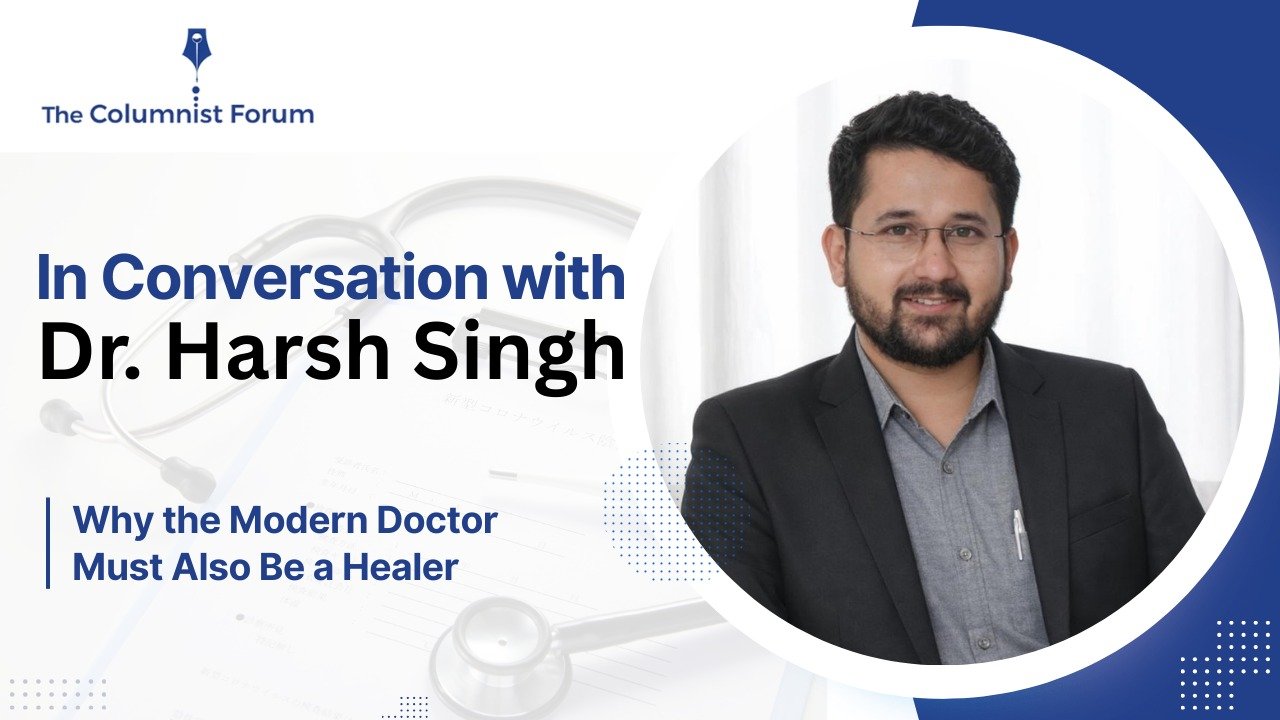

In a world where technology has enabled us to map every cell in our bodies and AI has allowed us to predict diseases before they occur, a strange paradox has been born. We have never been more technologically advanced as a medical community, yet patients often feel more invisible than ever. This highlights a powerful truth: the Modern Doctor Must Also Be a Healer. Dr. Harsh Singh, a Gold Medalist and Chief Surgeon at Rana ENT and Cancer Centre, suggests that medicine is currently standing at a critical crossroads. While we have the tools to cure the body, we are increasingly starving for the connection that heals the human.
The Weight of the Invisible
According to Dr. Singh, the most prevalent diseases of the 21st century – from Diabetes and Heart Disease to Autoimmune disorders – are often merely the branches of a much deeper tree. The roots are frequently buried in chronic stress, loneliness, fear, and burnout.


“We don’t see these in lab reports,” Dr. Singh notes. “A blood test can tell you the level of glucose in the veins, but it can never tell you the weight of the grief in a person’s heart.” As a specialist who has performed over 3,000 ear surgeries and hundreds of oncology procedures, he maintains that while reading monitors is vital, we have forgotten how to read faces.
The Power of Presence
For the patient, the doctor is not just a medical man, he is a symbol of hope. For the mother who is worried about her child, or the father who wonders whether he will see his children grow up, the medical setting is one of utmost vulnerability. As Dr. Singh puts it, “In such situations, the surgical plan is only half the cure.”
“Medicine is not just what you write on a pad; it is how you make a person feel when their world is falling apart,” he explains. Your voice, your reassurance, and your empathy – this is what he calls “real medicine.” It is the difference between treating a case and caring for a person.
Fluency in Two Languages
Dr. Singh is a strong advocate of a holistic approach that doesn’t replace science, but rather complements it. He describes the need for the “future doctor” to be bilingual, to know two different languages of communication:
The Language of Science: The nuances of ECGs, CT scans, HbA1c, and complex surgical margins.
The Language of Humanity: The need to recognize and address Fear, Pain, Anxiety, and Hope.
In doing so, the physician transcends the boundaries of healing and enters the world of transformation. In an era of rushed, ten-minute consultations, Dr. Singh views “slow medicine” – taking those five extra minutes to truly listen – as a revolutionary act.
A Journey of Perpetual Practice
While he has achieved great things as an award-winning researcher and specialist professional, Dr. Singh is also humble about the profession he is a part of and tells us that the term ‘practicing doctor’ is used for a reason. There is no final destination in the world of healing; there is only a constant journey of learning, growing, and refining one’s craft.