
BRICS 2026 Groupthink: The Psychology Behind Political Silence
The BRICS 2026 summit in New Delhi offers an interesting case study in how large political groups can construct consensus while avoiding direct confrontation. When eleven governments with different strategic interests, regional rivalries, economic priorities, and foreign-policy positions attempt to produce one declaration, the final language is rarely accidental.
The important question is not simply what the declaration says. It is also what the participating governments chose not to say.
A multilateral declaration often depends on carefully negotiated language. Governments remove words that could create disagreement, replace direct accusations with diplomatic terminology, and use broad principles that allow different members to interpret the same sentence according to their own interests.
That process does not automatically prove psychological groupthink. However, the BRICS 2026 discussion provides a useful framework for examining several psychological mechanisms that can operate inside large political groups: self-censorship, pressure toward consensus, collective rationalisation, diffusion of responsibility, social identity, and cognitive dissonance.
Rather than treating political silence as proof of agreement, we can examine it as a possible consequence of the way groups manage disagreement.
What Is Groupthink?
The concept of groupthink was developed by social psychologist Irving Janis to describe situations in which the desire for group cohesion and agreement becomes more important than critically evaluating alternatives.
In a group affected by strong consensus pressure, members may begin to suppress doubts, avoid uncomfortable information, and interpret disagreement as a threat to unity.
The key distinction is important.
Consensus does not automatically equal groupthink.
A group can reach consensus because its members genuinely agree. It can also reach consensus because disagreement is too costly, inconvenient, or politically damaging to express openly.
This distinction matters when analysing international organisations such as BRICS.
BRICS members do not share identical foreign policies. They have different relationships with major powers, different regional security concerns, and sometimes direct disagreements with one another. Therefore, a unanimous or near-unanimous declaration should not automatically be interpreted as evidence of complete strategic agreement.
Instead, we should ask how the consensus was produced.
BRICS 2026 and the Illusion of Unanimity
One of the classic characteristics associated with groupthink is an illusion of unanimity.
When everyone in a room appears to agree, individual members may assume that opposition does not exist—or that expressing opposition would be unnecessary.
In diplomatic settings, however, unanimity can be created through negotiation.
A government may object to particular wording privately and still accept the final document because the broader package provides enough value. Another government may decide that maintaining the appearance of unity is more important than winning a particular argument.
This makes public consensus difficult to interpret.
A declaration that contains no obvious dissent can therefore represent several different realities:
- Genuine agreement
- Compromise
- Strategic ambiguity
- Avoidance of confrontation
- Negotiated silence
- A combination of all of these
The psychological danger emerges when members stop challenging ideas because they assume everyone else supports them.
That is the real groupthink problem—not agreement itself, but the suppression of critical evaluation in order to preserve agreement.
Self-Censorship Inside a Large Political Group
Another important mechanism is self-censorship.
Self-censorship occurs when individuals deliberately withhold concerns, criticism, or alternative views because they anticipate negative consequences.
International diplomacy provides plenty of incentives for this behaviour.
A government may avoid directly criticising another BRICS member because doing so could:
- Damage bilateral relations.
- Complicate negotiations on unrelated issues.
- Create divisions within the organisation.
- Produce negative headlines.
- Make future cooperation more difficult.
The larger the group becomes, the more complicated these calculations become.
A country may have legitimate disagreements with another member while simultaneously needing that same country for trade, energy cooperation, diplomatic support, or regional negotiations.
Consequently, silence can become a rational political strategy.
This is where psychology and political strategy overlap.
A government does not necessarily remain silent because it has been psychologically manipulated. It may remain silent because speaking openly carries a higher political cost than staying quiet.
That distinction prevents the analysis from becoming overly simplistic.
Diffusion of Responsibility in BRICS Diplomacy
The psychological concept of diffusion of responsibility provides another useful perspective.
The basic idea is straightforward: when responsibility is distributed among many people, each individual may feel less personally responsible for taking action.
International organisations can create a similar dynamic.
If a controversial issue involves eleven governments, responsibility for confronting it is distributed across eleven participants. Every government can potentially assume that another member will raise the issue.
Eventually, nobody wants to be the first.
This dynamic becomes especially relevant when the group contains countries with competing strategic interests.
Each government can effectively think:
Someone else will raise the difficult issue.
But if everyone follows that logic, the difficult issue remains unaddressed.
The result is not necessarily deliberate conspiracy. It can emerge naturally from the structure of collective decision-making.
When BRICS Unity Becomes More Important Than Internal Disagreement
BRICS has a powerful collective identity.
The organisation is commonly associated with greater representation for emerging economies and a more multipolar international system. That shared identity can provide a strong incentive to emphasise common ground.
But strong group identity creates a potential problem.
Once governments become invested in presenting themselves as members of the same political project, criticism of another member can be interpreted as damaging the group itself.
This is closely related to social identity theory, associated with psychologist Henri Tajfel and his work on group membership.
People tend to categorise themselves into groups and attach meaning to those memberships. Political organisations can develop similar collective identities.
Within an international bloc, that can produce an uncomfortable contradiction:
How can an organisation present itself as a coherent alternative to established global power structures while simultaneously containing members with serious disagreements among themselves?
The easiest answer is often to emphasise common principles and minimise internal contradictions.
That is where carefully chosen diplomatic language becomes important.
The Power of Diplomatic Ambiguity
Words such as dialogue, restraint, sovereignty, stability, de-escalation, cooperation, and peaceful resolution are useful in international diplomacy because they are broad enough to accommodate different political interpretations.
One government can interpret “restraint” as a warning directed at an opponent.
Another can interpret it as support for its own position.
A third can see it as a general principle rather than a direct political criticism.
This ambiguity is not necessarily a weakness.
In fact, diplomatic ambiguity can be extremely useful.
It allows governments to reach agreement without resolving every disagreement.
However, ambiguity also creates a potential gap between language and accountability.
If a declaration consistently avoids identifying specific actors, it may become difficult to determine who is actually being criticised, what behaviour is unacceptable, and what concrete action should follow.
A statement can therefore sound strong while imposing very few practical obligations.
BRICS 2026 and Cognitive Dissonance
Another psychological concept relevant to the discussion is cognitive dissonance.
Cognitive dissonance describes the discomfort that arises when people hold conflicting beliefs or when their behaviour contradicts their values.
Political organisations can face similar contradictions.
BRICS can promote principles such as sovereignty, equality, dialogue, and a more representative global order while its members simultaneously disagree about how those principles should be applied.
The contradiction becomes particularly significant when governments support a principle in one context but interpret it differently in another.
Instead of openly resolving the contradiction, political groups can reduce discomfort through language.
The vocabulary becomes softer.
Accountability becomes dialogue.
Conflict becomes instability.
Disagreement becomes different perspectives.
Political confrontation becomes diplomatic concern.
This does not necessarily mean that the underlying problems disappear.
It means the language surrounding those problems becomes easier for everyone in the group to accept.
Why Political Silence Does Not Always Mean Agreement
It would be a mistake to conclude that every omission in a BRICS declaration proves groupthink.
Diplomatic documents are not psychological experiments.
Governments negotiate wording for strategic reasons. They may intentionally avoid naming countries because direct references could prevent agreement on the entire document.
There is also a practical distinction between public diplomacy and private diplomacy.
A government can strongly disagree with another member behind closed doors while accepting carefully negotiated public language.
Therefore, the absence of direct criticism in a declaration cannot, by itself, establish that members psychologically agreed with one another.
What it can demonstrate is that maintaining a common public position was prioritised over expressing every disagreement publicly.
That is an important distinction.
Why the BRICS 2026 Declaration Matters
The significance of the BRICS 2026 declaration lies less in whether it can be labelled simply as “groupthink” and more in what the document reveals about collective diplomacy.
A large political coalition cannot survive if every disagreement becomes a public confrontation.
At the same time, an organisation becomes less effective if protecting its appearance of unity prevents it from discussing serious disagreements.
This creates a fundamental tension:
Unity increases collective influence, but excessive pressure for unity can reduce honest internal debate.
That tension is not unique to BRICS.
It exists inside political parties, corporations, governments, international alliances, academic institutions, and even small teams.
The larger the group, the harder it can become to distinguish genuine agreement from negotiated compromise.
The Real Test of BRICS Unity
The strongest test of BRICS unity is not a photograph of leaders standing together.
It is not the length of a declaration.
It is not even the number of issues on which members can agree.
The real test comes when the organisation faces a disagreement that cannot be hidden behind general language.
If members can openly disagree while still maintaining functional cooperation, the organisation demonstrates institutional maturity.
If difficult disagreements repeatedly disappear into vague diplomatic language, the organisation may preserve its appearance of unity while avoiding the harder question of how that unity actually works.
That distinction will matter increasingly as BRICS expands and its members bring more competing interests into the same political framework.
BRICS 2026: Consensus or Groupthink?
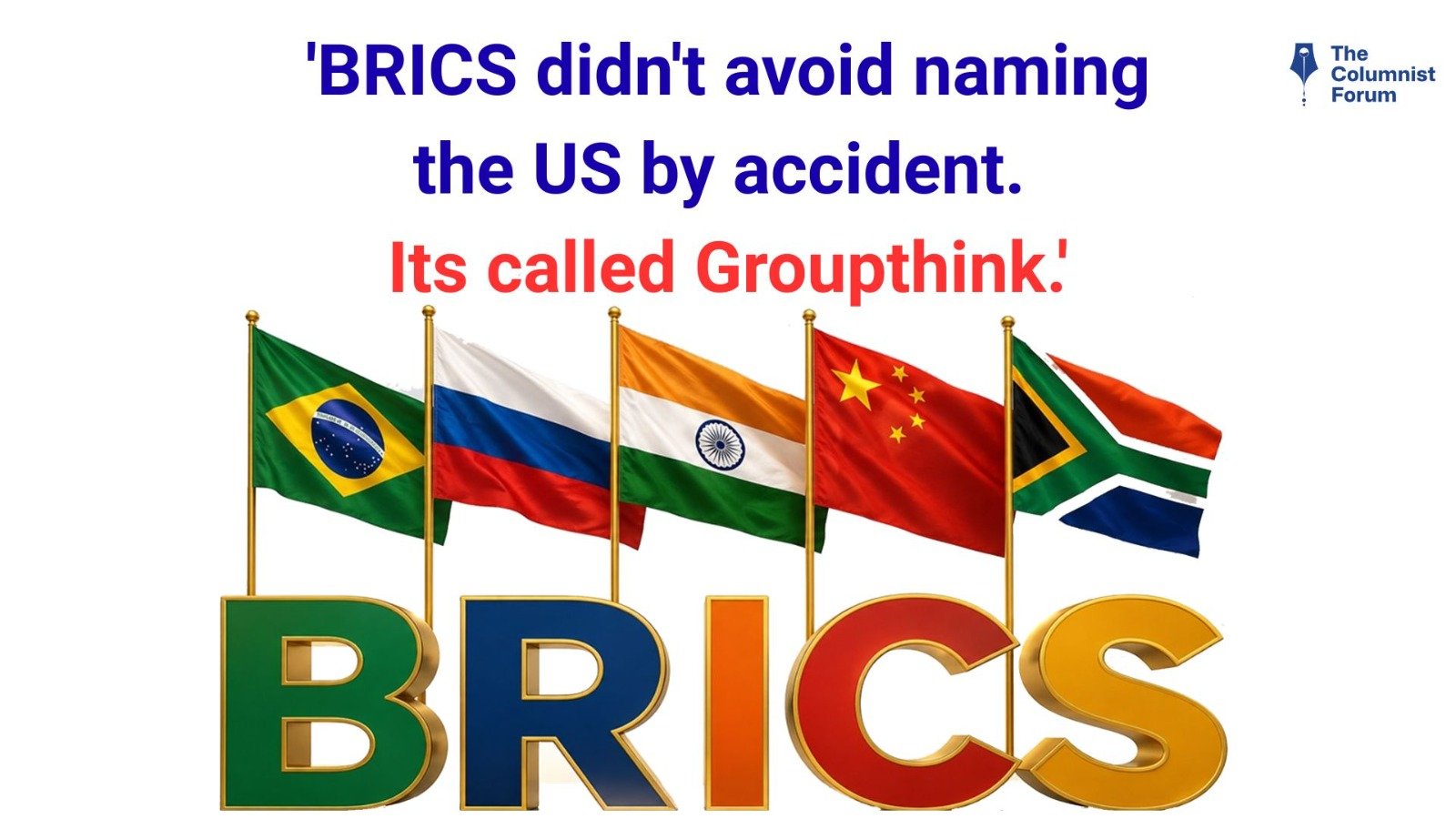
The most accurate conclusion is that BRICS 2026 should not automatically be labelled a textbook example of groupthink simply because its declaration avoided direct confrontation.
That claim would go beyond the available evidence.
However, the summit provides a valuable case through which we can examine the mechanisms associated with groupthink.
Self-censorship can discourage governments from raising controversial issues.
Diffusion of responsibility can make every member assume that someone else will address a difficult problem.
Social identity can make criticism of another member feel like criticism of the broader organisation.
Collective rationalisation can allow ambiguous language to satisfy different audiences simultaneously.
And cognitive dissonance can encourage political groups to use softer narratives when their stated principles collide with the behaviour or interests of their own members.
The result is a form of political communication in which what remains unsaid can be almost as significant as what appears in the final declaration.
BRICS does not need to be secretly coordinating silence for this dynamic to occur.
It can emerge from ordinary diplomatic incentives.
The leaders around the table may not agree on every major international issue. They may not even share the same interpretation of the organisation’s long-term purpose. But if preserving the coalition requires carefully managing those disagreements, silence becomes a political instrument.
That is why the psychology of group decision-making offers a useful lens for understanding BRICS 2026.
The question is not simply whether eleven governments agreed.
The more important question is what each government was willing to leave unsaid in order to keep the group speaking with one voice.