

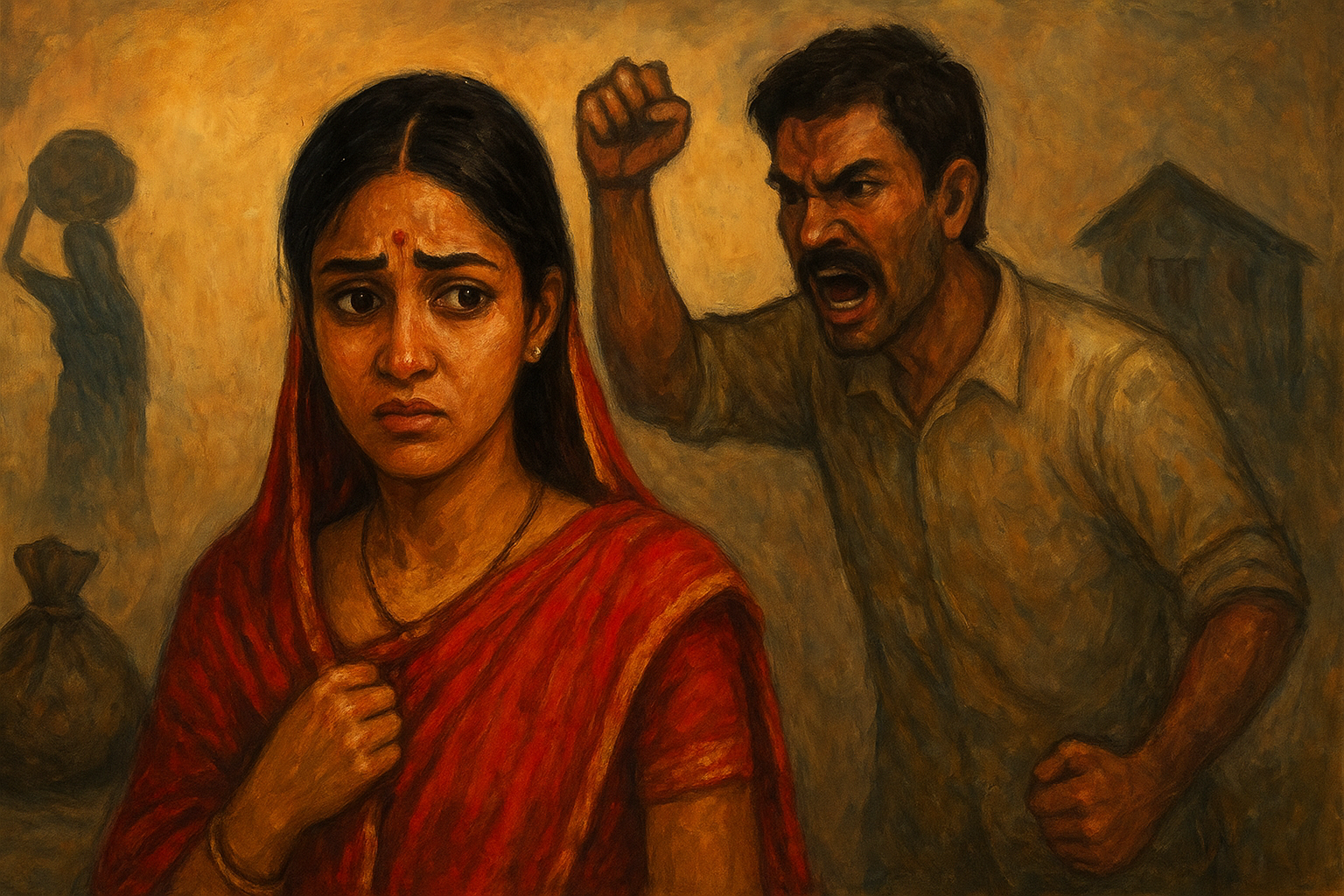
It happened in July 2025 in Tiruppur, Tamil Nadu. A 27-year-old woman named Rithanya died by suicide barely two and a half months after her wedding. Her family had already given 300 sovereigns of gold and a Volvo SUV worth nearly ₹70 lakh. But it wasn’t enough. It never is. The demands continued. The humiliation continued. And then, one morning, her life ended. The news cycle lasted 48 hours. Neighbours said things like “Poor girl, she was too sensitive.” The husband’s family insisted “It was just a misunderstanding.” And India moved on.
When violence against women is familiar, it no longer shocks. It simply circulates, gets consumed, and dissolves.
Dowry is one of those violences. It is not an incident. It is a system - maintained, protected, inherited, worshipped.
Every year, over 6,000 women in India are reported dead due to dowry-related violence. That’s just the reported numbers. The rest are written off as mental instability, kitchen accidents, gas cylinder leaks, “she couldn’t adjust.” Innocent words used as smoke screens over murder.
But dowry is not just the story of these deaths. It is the story of everything before that.
- The negotiations.
- The expectations.
- The jokes disguised as warnings.
- The “tradition” defended by love.
It begins quietly. Long before any wedding date is set. Sometimes even before the girl is born. Families start “saving” - not for her education, her house, her independence, her future - but for the day she will be handed over. The daughter was a transaction. Not metaphorically. Literally.
Everyone knows the script. Hindu, Muslim, Christian. North, South, East, West. Urban, rural, NRI. The colleges change. The accents change. The rituals change. The transaction does not.
We just stopped calling it dowry.
Now we call it “gifts.”
The language became polite, so the violence could stay.
A fridge for the new house.
A car to help them settle.
Furniture, of course, what will the girl sit on?
Gold - not because they asked, no no, just our love.
Wedding expenses, obviously, the boy’s side cannot be expected to handle everything.
Every time someone says, “It’s just how things are done,” a woman somewhere pays for it with her life.
Even among the so-called educated elite — the ones with tote bags quoting Virginia Woolf and Instagram bios that say “feminist” — the story does not change. The only difference is that the deal is negotiated with a smile. A polite dance of expectations.
The girl’s father is told, “We don’t believe in dowry, but of course, the wedding should be on your side.”
The boy’s mother gently suggests, “Just give whatever you wish. We don’t have demands.”
There are always demands. They’re just delivered in the language of civility.
Because this is not just about money. It is about power. The power to say your daughter is not enough in herself. She needs ornaments, consumer appliances, a four-wheeler, a wedding planned like a corporate event, photographs staged for people who will never care. Without these additions, she is not worthy.
Women know this. Girls learn it young. You can see it in how they grow up conditioned to never be too expensive. Not too talkative. Not too opinionated. Not too independent. Not too proud. A daughter who will be easy to “settle.”
Because marriage is not framed as a partnership. It is framed as a transaction of value, and the woman’s value is always considered less. So she must be compensated by objects.
And if the objects fall short, she will pay with herself.
The emotional labour of maintaining a marriage rests on her shoulders. The burden of “adjustment” is hers. The failure of the relationship, even when rooted in abuse, will be pinned on her inability to “keep the peace.” She is told to tolerate. To compromise. To endure quietly. To protect the reputation of both families.
Men are not raised to endure. They are raised to expect. And they inherit that expectation like property.
This is why the law — the Dowry Prohibition Act (1961) — barely matters.
You can outlaw a transaction.
You cannot outlaw a culture that believes women are liabilities.
Dowry is not simply an old habit. It’s a structure of control, reproduced at every wedding, every family discussion, every “tradition,” every aunt saying “daughter’s marriage is our responsibility.”
Responsibility is a soft word. It means debt. It means obligation. It means she is a project to complete, not a person.
Parents who claim to love their daughters still participate in their commodification. Not because they are cruel, but because they are terrified. Terrified that if they don’t comply, their daughter will suffer. Terrified that she will be mocked. Terrified that she won’t “find a good husband.” Terrified that marriageability is the measure of girlhood.
Fear makes everyone accomplices of everyone.
And so, even when families insist they are progressive, even when they proudly say “We won’t take dowry,” they still expect the girl to bring her body, her labour, her obedience, her silence.
Her life.
This is dowry too.
Dowry is not only gold and cash.
Dowry is the transfer of freedom.
The real cost of marriage in India is a woman’s autonomy.
Which brings us back to the river in Tiruppur. To a young woman who had everything we were told protects women — education, a wedding approved by families, wealth, ornaments, social standing. But none of it protected her. Because the system is not protecting women. It is protecting itself.
When a society believes that a woman’s value is tied to what she can bring into a marriage, violence is not a possibility — it is an inevitability.
We can blame in-laws. We can blame individuals. But dowry is not the cruelty of a few families. It is the design of a nation.
And we have all participated in it.
Change will not come from laws. It will not come from awareness workshops. It will not come from posters in police stations.
It will come the day a bride walks into her marriage empty-handed but equal.
No gold.
No fridge.
No car.
No apologetic smile.
Just herself.
And the day her family says:
If she is not enough,
the marriage is not worth having.