

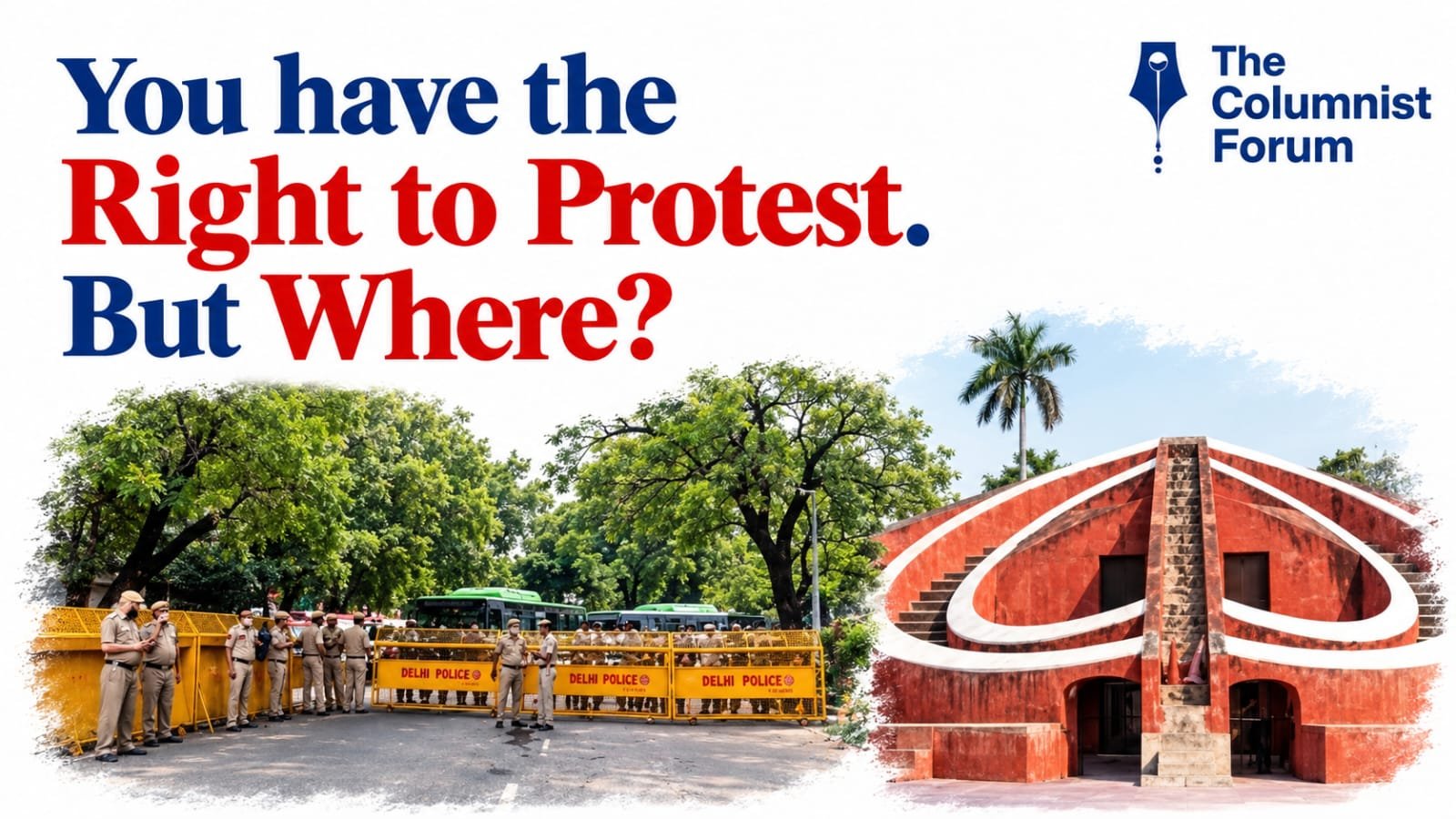
The Delhi Police on Sunday, October 11, 2026, has denotified The Jantar Mantar as a protest site. This came in after the anticipation of more protests to be held there in coming days. This raises some enduring questions: Whether the denotification was a necessary step to maintain law and order or merely to undermine the right to protest. A protest is not a mere gathering of people. It entails within itself the voices of public, their aspirations, their message to the government and so much more. Therefore, not only the gathering but the place where people gather becomes important. A demonstration outside the Parliament holds greater significance than the one far away from it. In a democracy, along with the right to protest, it is also important that the protestors are heard and answered.
From Boat Club to Jantar Mantar
The protests in Independent India were organised across streets, public grounds and around the vicinity of governmental bodies. For instance, Ramlila Maidan became an historic site for political mobilisation, from Kashmir Satyagraha in 1950s to JP Narayan’s movement in 1970s and Anna Hazare Anti-corruption agitation in 2011. Earlier, Boat Club lawns was a prominent site for demonstrations. Most of the mass agitations were held at this particular place near India Gate, until the massive farmer’s protest led by Mahender Singh Tikait in 1988 has raised some serious concerns about the traffic issues in the area and proximity to the VIPs. Subsequently, mass mobilisation at the Boat Club was restricted.
However, it did not vanish as a protest site overnight. Several protests still held at that place but restrictions were tighter through Police actions and administrative controls. At this backdrop, the Jantar Mantar then became and alternative site. It is in 1993, that a major protest has been shifted to Jantar Mantar. Gradually, Jantar Mantar has acquired significance beyond its geographical location. It became a household address for agitations or mass mobilisation for raising voices and demanding accountability. Its proximity to the political powerhouses gave the protests a visibility that far away locations may sometime fail to gather.
The Fundamental Right to Protest
The Right to protest is embedded in the fundamental rights guaranteed by the Constitution of India. Article 19(1)(a) provides for all the citizens; the freedom of speech and expression and Article 19(1)(b) guarantee the right to assemble peacefully. These are, however, subject to reasonable restrictions. The Supreme has repeatedly, through its various judgements recognised that the right to assemble does not confer an unrestricted right to occupy every public space to the inconvenience of public at large. Authorities may put reasonable restrictions to maintain law and order and the rights of other citizens. However, an important distinction shall be made ensuring that such regulation does not become a means of silencing dissent. What is a reasonable restriction and what restriction supressing the right to dissent depends on the facts and circumstances of each case. In Himmat Lal K. Shah vs. Commissioner of Police, Ahmedabad (1973), the Court recognised that authorities can regulate public meetings on streets, but cannot exercise that power arbitrarily to deny the right of assembly. In the case of Mazdoor Kisan Shakti Sangathan v. Union of India, peaceful protest has been recognised as a fundamental right under Articles 19(1)(a) and 19(1)(b). It called for a balance between protesters’ rights and residents’ convenience, directing authorities to frame guidelines for regulating demonstrations at Jantar Mantar and the Boat Club area.
Designating a particular place for protest: a reasonable restriction or curtailing the right?
It is only in 2022, that a protest venue is regulated by the state through written administrative orders, rather than merely police actions. The Delhi Police order on 28 April 2022, laid down guidelines for holding protests and demonstrations at Jantar Mantar and nearby areas. There were some restrictions only, like seeking permission beforehand or the timings, there was no blanket ban on organising protests at this site.
The issue arose only after the 11 October order of the Delhi Police. This order can be scrutinised on the grounds of violating right to protest of the citizens by restraining them from protesting at a location which has geographical as well as historical significance for mobilisations demanding rights in a democratic setup.
General Comment No. 37 (2020) on Article 21 (The Right of Peaceful Assembly), ICCPR, published by the United Nations Human Rights Committee, addresses the location of assemblies. It establishes that because public assemblies are a form of communication, “protesters should be given access to public space within sight and sound of their target audience”. The real test is not how many people it can accommodate but how effectively it serves the purpose. In this regard, Jantar Mantar has been a site where citizens can reach easily, assemble peacefully and communicate their demand effectively and promptly to those in power. It is in the Vicinity of major governmental hubs.
A democracy does not promise that every protest can take place the way organisers decide. Indeed, there can be restrictions on the way of organising protests but a ban altogether, serves no purpose other than the curtailment of the right itself. The regulation of public spaces reduce dissent to an exercise of administrative convenience, and so is the order of Delhi Police denotifying Jantar Mantar as Protest Site.
The decision is under challenge in The Supreme Court. On 15 October, 2026, the Court has issued the notice to the Delhi government and Delhi Police seeking their response.