

I am writing this from India, and this is not about any country I live in or belong to. It’s about what’s happening to women a few thousand kilometers away, right now, in Afghanistan.
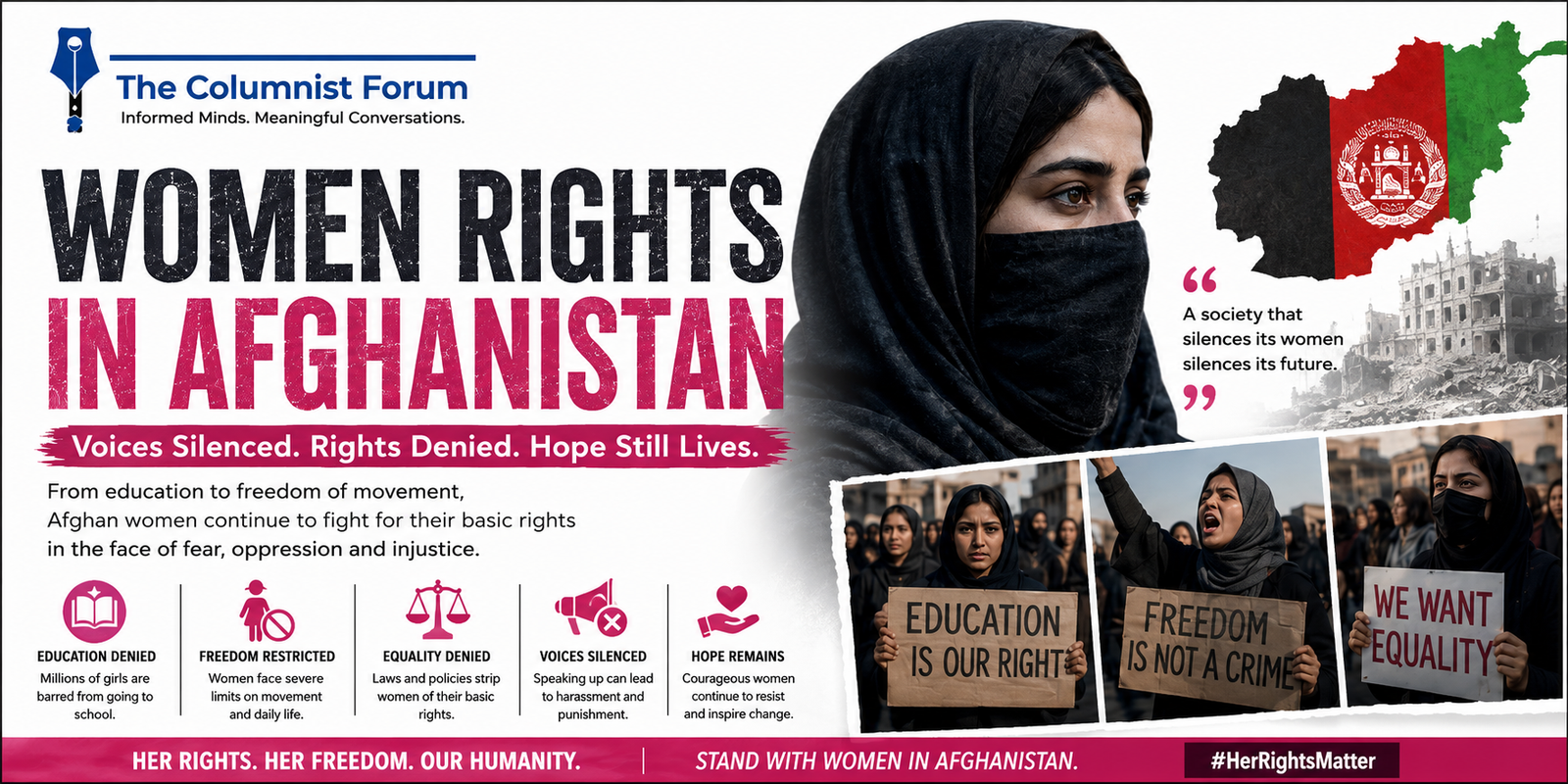
I saw a series of images yesterday. Blue burkas. A grown man holding a stick behind a line of women. An 11-year-old girl sitting next to her fiancé, who looked old enough to be her grandfather. And a caption that said Afghan women have officially lost all rights to live freely.


Whether a woman wears a burka or not should be her choice. That’s not what unsettled me. What unsettled me was that when I looked at that photo, the women didn’t even look like human beings wearing something. They looked like clothes were walking on their own. I have never seen anything like it.
I did not scroll past it. I could not.
I went looking for the facts. And what I found was worse than the post.
This is not old history. This is 2026.
Since 2021, the Taliban has passed more than 230 rules. One of them, from January 2026, says a husband can hit his wife, as long as he doesn’t break her bones.
Read that again. A law that decides how much pain a woman is allowed to endure before it counts as too much. This is not ruling. This is not tradition. This is men writing down, in ink, exactly how much they are allowed to hurt someone they claim to love.
In May 2026, a new rule removed the minimum age for marriage. Earlier, a girl couldn’t legally be married before 16. Now, that protection doesn’t exist.
And on top of that, they are marrying off very young girls to men who could be 60 years old. What religion allows this? What justice is this? A child can be handed over to a grown man, and there is no law left to stop it.
Women also cannot travel without a male relative accompanying them. Not to another city, not even to the market, not anywhere. A grown woman needs permission and company just to move through the world, like she’s incapable of existing on her own.
And education for girls stops at class 6. That’s it. A girl of ten or eleven has to stop right there, only because she’s a girl. Boys the same age just keep going.
Since September 2025, women are not allowed to even walk into UN buildings. Armed men stop them at the gate. Years ago, women government workers were sent home and still given a small salary, just to keep them quiet. In January 2026, even that stopped. Their salary was cut off, and their jobs were completely gone. No warning. No explanation.
They didn’t just take away her job. They took away the last thread connecting her to the outside world, and did it without even the courtesy of a reason.
Since 2024, women can’t study to become doctors. A UN expert said that without female doctors, women who can’t be treated by male doctors will start dying of things that could have been treated. He called it something close to killing women slowly.
So let this sink in properly. They don’t let women become doctors. And they don’t let women be treated by male doctors either. So when a woman falls sick, there’s simply no one left who’s allowed to save her. That’s not modesty. That’s choosing her death over her covered face. That is not protecting women. That is hating them enough to let them die.
In June 2026, at least 30 women were arrested in one city for wearing perfume. When people protested, Taliban forces opened fire. At least two people died. One of them was a child.
A smell got a woman arrested. A protest against that got a child killed. I don’t have words polite enough for what that is.
Now here’s what makes all of this even harder to accept quietly.
The Taliban traces its roots to the Deobandi movement, which began at Darul Uloom Deoband in India in 1866. That movement was a reaction to British colonialism, meant to preserve traditional Islamic education. It was never about creating militants, and it never argued that women should not be educated. So when I read that, I couldn’t help but ask: where did this version even come from, then?
In fact, if we talk about standard Hanafi Sunni jurisprudence, which the Taliban claims to follow, treats education as a religious obligation for both men and women, not just men. So even by the standard they claim to represent, banning girls from school past class 6 is not following their own religion. It’s rewriting it to fit their control. That’s what makes me angrier than anything else here. They are not even honest about what they are doing. They are hiding behind a religion and twisting it into something it was never meant to be.
And it’s not like every country following Islamic law does this. Saudi Arabia, Iran, and Qatar all govern using Islamic frameworks, and none of them ban women’s education the way the Taliban does. In Iran specifically, women have made up around 60 percent of university students in recent years, according to UNESCO data. These countries have their own share of problems when it comes to women’s rights, and I am not holding them up as ideal. But none of them come close to this level of extremity. Women there are still allowed to become doctors, engineers, and graduates in large numbers.
So no, this is not Islam. Call it what it actually is: a small group of men who want total control over women, using religion as a shield so no one questions them.
Here’s what I keep coming back to: this is not men ruling women. Ruling still means some responsibility, some care for the people you rule. This looks like something else. This looks like men who hate that women exist, speak, study, and live like human beings instead of property.
And the part that makes me most uncomfortable is the year. This is 2026. Right now, while we scroll past it on our phones, a girl younger than we can imagine is being married off. A woman somewhere is dying because there was no doctor left allowed to see her face.
We have the freedom to speak. We have platforms, however small. If we have all of that and still stay quiet in front of this, then what is that freedom even for?
I know one article won’t change a government. But once you have seen this clearly, staying quiet is a choice too. And I refuse to make that choice. So talk about it. Share what’s actually true, not just a caption people see and move on from. If you can, support the people actually working for Afghan women on the ground. And don’t let five years make this feel like old news, because for the women living it, nothing about this feels old.
So let’s be clear: Some things are not political. Some things are not cultural. Some things are just wrong. This is one of them.
If this moved something in you, say so. Talk about it with someone today, because silence has never protected a single woman in Afghanistan. That is where raising your voice actually starts.
And if you can’t even raise your voice for such cruelty, what’s the point of having one?