

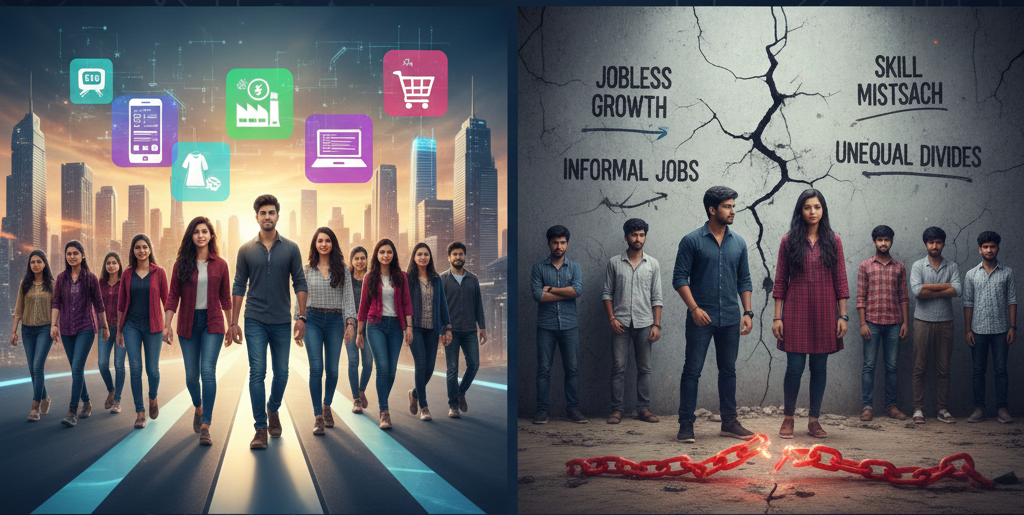
Currently, the Indian economy is reflecting a very strong revival trend. Recent statistics showed that real GDP rose by 7.8% in Q1 of FY26, reflecting a strong rebound and placing India among the fastest-growing major economies of the world.
It is not an abstract rise; in a predominantly young population, it means something in real life: employment, way of life, career options, goals. Where there’s opportunity, there’s challenge too. Rising GDP is a promise as much as it is a call to be prepared for the young India of today.
What’s Firing the Indian GDP Growth Today?
So, to say parentally, first and foremost in the countryside, consumption and increasing domestic demand are doing their contributory role. During the last quarters, there had been an upsurge in personal consumption and expenditure in the countryside.
Service and manufacturing are doing well. Service sector continues to be an important growth engine while the allied sectors like manufacturing, construction, and so on record steady growth.
Third, from the huge capital spending, infrastructure investment was even bigger. That is, the more a foundation is built for further growth that should be sustainable with an increasingly digital economy and connectivity from both the public and private sectors.
Fourth, enabling business conditions, digital penetration, and changed consumer habits facilitate development in entrepreneurship and startups, newer forms of business models, and create opportunities beyond conventional employment.
Put together, these drivers do suggest that this rise in GDP is more than a cyclical blip; it is built upon structural changes which may well be propitious for the rising generation trying to carve their path.
What Rising GDP Could Mean for Youngsters: Everything Is an Opportunity
With growing GDP, some of the emerging possibilities for the youth in students, fresh graduates, and early-career professionals in India will include:
Opening diverse service, manufacturing, and digital sectors shall result in various avenues of employment and career profiles opening up. There is a requirement for human resources. Youths may opt for traditional or newer emerging careers like digital media, e-commerce, content creation, marketing, technology-enabled services etc. It is this growth that requires skilled and able people to adapt to any change, learn and re-skill. This opens new kinds of occupations in a country like India- away from the hitherto traditional ones linked with formal degrees
The increased size and consumer demand in the market creates ample opportunities for young entrepreneurs to create their ventures around retail, fashion, lifestyle, digital services, sustainability etc. In fact, those who have already started off with small experiments in running businesses or side hustles or even social-media-based brands might find this a good time to scale up their initiatives.
Improvement in lifestyle and consumption potential: trickle-down economic growth means higher disposable incomes, greater consumer expenditure and improved lifestyle choices relating to quality education, leisure, and entertainment. For the young starting on life’s journey, independence and aspirations are well within reach.
In other words, for a generation which has grown up on disruption and transition, a surging India can indeed provide a platform, provided they are ready to adapt. But having only one hook on which to hang all hope, GDP growth alone does not denote success and problems persist. Certainly, not all is uniformly rosy.
Challenges Young Indians Must Face
There are real structural and social challenges with which young Indians have to remain cognisant.
Jobless growth and inadequate job creation: though the economy is growing at 6–8%, this rate is considered by critics not adequate to absorb millions every year into its workforce. Similarly, various academic studies indicate that India needs growth of ~12% annually if it is to meaningfully address the shortfall in employment.
Informal or low-quality employment is becoming the new normal. Most of the jobs being created nowadays are either not formal in nature or are not stable. The pervasiveness of informal employment, gig work and contractual roles might have implications for unpredictability, a lack of benefits and limited long-term security.
Skill mismatch and education gaps: Despite better GDP numbers, many graduates might not have industry-relevant skills and hence be either under-employed or mismatched between jobs and aspiration. It serves as a word of caution for youth who are too heavily reliant on formal degrees.
Unequal distribution, regional, gender, and urban–rural divides: Growth is likely to favour urban, better-connected youth, while several rural or otherwise marginalised young people, especially women, might be left behind because of persistent structural obstacles.
Thus, though rising GDP is necessary but not a sufficient condition for youth prosperity, the question remains if growth will translate into inclusive, equitable opportunities.
What Youth Can Do to Make Use of the Growth-Boom: A Call for Proactive Adaptation
Opportunities and pitfalls given, here follows a set of strategic recommendations for the young people eager to catch on with the growth surge:
Invest in lifelong learning and competencies, not just degrees—skills like digital literacy, soft skills, adaptability, and domain-specific knowledge. Jobs are changing; dogmatic reliance on traditional education may no longer be enough.
Career choices should be open to all kinds of options—emergent sectors like services, digital sustainability, manufacturing—and should not be confined to traditional white-collar jobs only.
Leverage rising domestic demand: As incomes rise and consumer base expands, sectors like lifestyle, retail, fashion, media, content creation, experiential services—often driven by young consumers—present opportunities.